This Baby Dog Eats in a Highchair

By Taylor Huestis

Megaesophagus isn’t just a mouthful to say. It’s a big deal… especially for a little puppy like Potato.
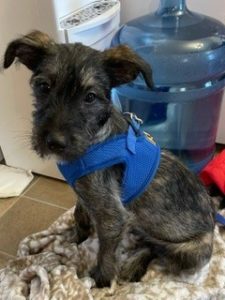
Luckily, Potato was one of 10 pups born in the SPCA’s care where they had access to around-the-clock support.

His mama, Princess, was a pregnant stray brought to safety at the Cape Breton SPCA. To help Princess, she made the journey up to our sister shelter, the Colchester SPCA, where she met a wonderful foster family.

The pups and mama were doing well in foster care. That is, until it was time to start introducing food. There was something very unique about Potato.

Normally, your esophagus has the important job of transporting food from your mouth to your stomach. But with a Megaesophagus, the esophagus expands. Pets like Potato have a harder time trying to swallow and keep their food down. It’s a serious condition that requires special treatment.
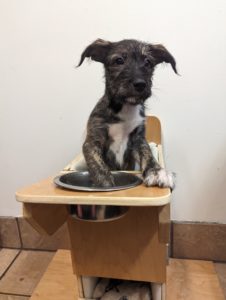
Part of that treatment included a puppy highchair!

This way, Potato could eat his blended-up food staying upright and gravity could do all the work. Potato was getting the hang of this new way of eating. But while the other pups and mama found loving families, Potato continued to wait and wait. He needed someone very patient and understanding of his needs.

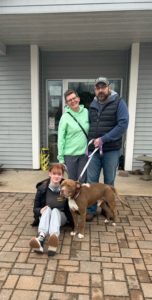
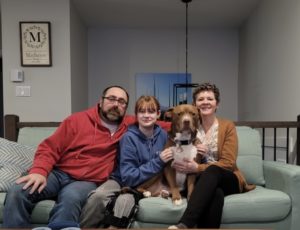
Thankfully, Potato met Maria Norris-Boudreau.

“From the first moment I met Potato (who we renamed Tater) I knew I wanted him in my life,” reflected Maria. “He’s a very handsome and gentle boy. With my health care background I was drawn to him and destined to adopt him and give him the best life that I could.”
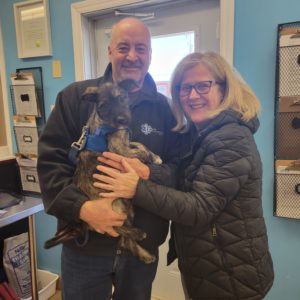
Maria is a retired Registered Nurse who worked at the IWK Hospital in high-risk obstetrics for 32 years. She begged her husband, a retired Advance Care Paramedic, to come meet him. They fell in love and knew they just needed to take Tater home.

“Because of his Megaesophagus, Tater eats a slurry diet consisting of ground up kibble and canned food mixed with water,” Maria explained. “We feed him four times a day. Tater acts like a starving puppy at each feed. We stop several times during his meal to slow him down and he remains upright for 5-10 minutes after eating. He has no issues doing this. Tater also loves plain Greek yogurt, pure pumpkin, and apple sauce for treats.”

Although feeding time requires lots of focus… overall the family is just having so much fun together.

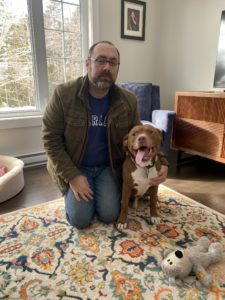
“My husband’s favourite moment was realizing how well Tater can play fetch,” giggled Maria. “Tater loves running after a ball and most times returns it. Tater is learning to sit and provides us with lots of cuddles. We have only had Tater for a short time but he has quickly become a loving part of our family. We consider Tater to be our special boy!”

Despite the challenges pets like Potato face, they have such beautiful and resilient spirits. And thankfully, there are wonderful families that can see just how special they are.

“We would absolutely encourage people to consider adopting animals with special needs if they are in the position to provide lots of time, patience, and love,” shared Maria. “All animals deserve to be cared for in a loving home.”

Taylor Huestis

Taylor is the Communications & Development Officer with the Nova Scotia SPCA and proud adoptive fur-parent to two cats named Bonnie and Boy (yep - that is his real name) and a palliative pup named Hazel. Connect with Taylor at thuestis@spcans.ca or 902-222-0378 today.

A Decade of Devotion: Kara’s Volunteer Journey with the SPCA

By Judy Layne

Sometimes it’s a family member who inspires us to volunteer with homeless animals. Sometimes it’s a beloved pet. And sometimes it’s both. Take Kara Hyland for instance, one of the Nova Scotia SPCA’s paw-some volunteers, who just celebrated 10 years of giving back to the animals!

Kara initially learned about volunteering from her older sister who was a long-time volunteer with the SPCA. Kara recalls “I loved hearing her stories about all the animals and the progress that they’d make. What eventually pushed me to sign up, and for dog care in particular, was my rescue dog Pippin that I adopted in 2012. He was adopted from the SPCA of Western Quebec, but he actually travelled all the way from Nunavut. He was a stray there and needed a lot of work and training to overcome his fear-based reactivity. Working with him made me see how patience, love and understanding can go a long way with animals.”

Over the years, Kara was happy to do whatever was needed, whatever would help. She relates “I’ve been a dog care volunteer for the entirety of my tenure with the SPCA. I have also done Girl Guide presentations at the shelter, which I loved because it was talking to children about what the SPCA does and actually having them meet some of our shelter animals. I’ve filled in as an adoption counsellor, which is always rewarding when I get to see our shelter animals leave for their fur-ever homes!”

Kara has also done various outreach events, such as helping to host a puppy event for donors and volunteering at the Evergreen Festival for SPCA pet photos. She says “At the Festival, there was a line-up for the whole day; a lot of pet parents had to wait a bit for their pets’ pictures to be taken but they were all so patient and just happy to participate. Some of the pets were SPCA alumni, and I loved talking to the owners about their pets and interacting with them while they waited. They were all so generous with their donations, it was a great experience for everyone!”

Kara has even done a pet therapy session at Dalhousie in conjunction with St. John’s Ambulance. “A big passion of mine is talking about the therapeutic effect animals have on us,” explains Kara. “When the SPCA and the therapy dog program at St. John’s Ambulance decided to do a dog session at Dalhousie during exams, I was happy to help! University students face a lot of pressure and most times, don’t have the benefit of having a pet of their own (busy schedules, no pets allowed in dorms or apartments). Giving the students an opportunity to take a break from the stress and interact with some adorable dogs was so much fun.”

Ask any volunteer and they’ll tell you how rewarding the experience is. Kara is no exception. In fact, she calls the shelter her ‘Happy Place’ and looks forward to going there every week where she fulfills two volunteer shifts – on Wednesday and Saturday evenings. She explains “The best thing about volunteering is the animals. I love seeing them come out of their shell once they realize they’re safe and cared for at the shelter, and when their personalities start to blossom.  I love watching them progress and start to open up with all the staff and the other volunteers. And most of all, I love it when someone special comes in, recognizes how amazing they are and decides to take them home! I also really appreciate and enjoy working alongside the other volunteers and staff who are as passionate about the animals as I am.”
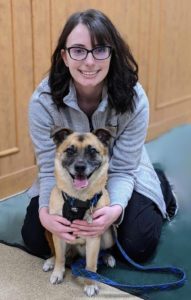
Kara shared that many times when she talks to people about volunteering at the shelter, they ask her two questions: ‘How do you not take every animal home?’ – and – ‘Is it sad being there and seeing all the animals without homes?’  Kara says “I can’t take credit for having the willpower to not adopt every animal – my dog Pippin needs to be the only pet in the home, otherwise I probably would have a whole pack by now! As for seeing animals in the shelter, sometimes it can be sad, but I truly think the good outweighs that. When you see a dog wiggle their bum for the first time when you approach their kennel door or hear a cat purr when you give them chin scratches, it makes me feel good that I’m playing a part in the SPCA’s mission of finding animals their happily-ever-afters.”

There are so many different ways to volunteer at the SPCA both inside and outside the shelter. SPCA volunteers are actively involved at every stage of the rescue process.  From trapping and transporting feral cats, to keeping kennels and shelters clean, to walking dogs and cuddling cats, to doing office and maintenance work, to fostering animals, to taking photos of adorable adoptables and helping at various events, to working in our Thrift Stores, to fundraising.

Kara encourages everyone to consider volunteering and getting involved. She states “Apply online or send an email to the Volunteer Coordinator and they’ll be sure to have many different options of how to help that would suit your needs and wants! You can be part of a great community and make a difference in the lives of homeless animals.”

The SPCA is incredibly lucky to have hundreds of amazing volunteers across the province that share their time and talent and is extremely grateful for their tireless work. But with thousands of abused, neglected, injured, homeless animals to care for annually, there is much work to be done and never enough hands. Are you ready to put your paw up and help? To find out more information and to apply, click here. You can also contact Catherine, SPCA Volunteer Coordinator at volunteer@spcans.ca or call 1-844-835-4798. Come see for yourself why the SPCA has been voted as one of the Best Place to Volunteers in The Coast!

Judy Layne

Judy is a dedicated volunteer with the Nova Scotia SPCA. She is committed to speaking for animals who cannot speak for themselves.

Worth the Wait: After 155 Days, Forrest Finds a Fabulous Family!

By Judy Layne

It’s been said that good things come to those who wait. There’s a special doggo who knows this is true. His name is Forrest.

Forrest was brought to safety at the Cape Breton SPCA by Enforcement Officers in July 2023. Approximately  4 years old, he had patchy fur and broken teeth. After receiving needed medical treatment, Forrest was put up for adoption. He was the full package – curious, playful and looking for a family with a sense of adventure that matched his own.

Yet for months, Forrest watched as people passed him by to adopt other dogs. It was surprising that there didn’t seem to be much interest in this sweet bouncy boy, as he had captured the hearts of the staff members and volunteers who cared for him. Forrest waited and waited for a special family who would look into his eyes and see the wonderful loving soul inside. Because the SPCA never gives up on pets, they decided that perhaps Forrest needed a new space to help find his perfect match, so he was transferred from Cape Breton to the Kings shelter.

Finally, after 155 long days of hoping for a fur-ever home, Forrest’s wish came true! On New Year’s Eve, Forrest was officially adopted by April MacIntyre and her family. Perhaps it was fate that Forrest’s new life would begin with the new year.

The family had started browsing the SPCA website over Christmas holidays. Their 13-year old daughter Sophie had wanted a dog for a long time, but they previously had cats and a dog was not in the cards then. They recently had to say goodbye to their last beloved kitty Finnigan and it seemed like the right time to think about getting a dog.

They didn’t have a specific breed or size of dog in mind, but they did want to adopt an adult dog. April explains “We were looking for a dog that was good with kids and we understood that Forrest was. When we learned how long he had been at the shelter, our hearts went out to him. After some emails back and forth with Hanna at the Kings shelter to make sure we were a good fit for Forrest, we decided to make the 2-hour trip from Dartmouth to Waterville on New Year’s Eve to meet him. He was immediately very friendly with all three of us, and who couldn’t love that sweet face?! He was also very well mannered and curious. We decided that Forrest was meant to be with us.”

Forrest made himself at home as soon as he arrived. April’s husband Roddy says “He wasn’t timid at all and immediately chose his favorite spots on the couch and in our bed! We had family over that evening and he spent the New Year’s Eve snuggling with them on the couch. He loves being around people and is so friendly with anyone that visits our home.”

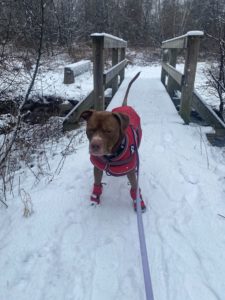
Forrest is definitely living his best life. “He enjoys exploring the neighborhood and particularly loves to walk in the park across the street from our house,” says April. “He has several stuffies and chew toys (one of his favorite activities is to tear the stuffing out). And more than anything, he loves to cuddle. We believe he often thinks he is a chihuahua rather than the 65-pound lap dog he actually is! He is not a fan of the snow, especially if it is falling (perhaps he was left out in cold, stormy weather in his old life). He now has snow boots and a warm winter coat to keep him comfortable when we go on walks. He catches everyone’s attention in the neighborhood!

Forrest has made a real difference in the family’s life. April shares “We are definitely more active than we have been in a long time! Forrest gets two to three walks a day and at least one of them is done as a family. At the same time, we are more grounded now; happier to stick close to home and do things we can include him in. Forrest is so loving and so goofy! He always has us laughing.”

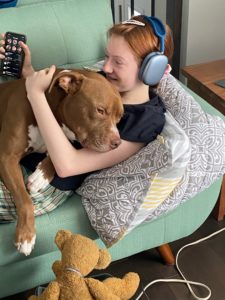
Forrest has a sensitive side that was brought out when Sophie had knee surgery in January. Forrest has been a constant companion for her during her recovery time and loves to snuggle on the couch with her. April says “He can’t wait until he is allowed to sleep in Sophie’s bed with her again! He is very diligent with her and seems to understand that she is recuperating.”

The family knew upfront that Forrest was curious, and they now always joke about how nosy he is. “He sniffs at everything and will even stick his head into anyone’s bag or purse when they come to our house!” chuckles Roddy.  “We are a camping family and we can’t wait to take him camping this summer.”

I asked what advice they would give to people who are considering adopting a pet who may have been at the shelter for quite a while. April says It’s definitely important to do your research and be sure that not only is a potential pet the right fit for your family, but that your family is also the right fit for that pet. Make certain that your home is ready to bring that pet into and ensure it is a welcoming loving space for an animal that might not have had that security before.”

The family reflects “We think there is often a misconception about older animals or animals that have been in shelter care for a long time. People may think that they have behavioral issues or some other challenge that has kept them there, but honestly, keep an open mind. Don’t overlook a potential pet because you think they may be challenging. Forrest has certainly shown us that that is not the case! He is such a sweetheart and so well-behaved and well-mannered. We love him dearly. It saddens us that he spent such a long time looking for his family, but we are definitely happy he waited for us.”

And the family’s final thoughts? “Our only regret is that we didn’t meet Forrest 154 days sooner!”

Judy Layne

Judy is a dedicated volunteer with the Nova Scotia SPCA. She is committed to speaking for animals who cannot speak for themselves.

From Stray to Saviour: Cash and Jodi’s Fated Journey

By Kirsten Millar

When Jodi Van Iderstine’s beloved service dog, Sunshine, received an unexpected cancer diagnosis and was given weeks to live, Jodi was faced with the task of finding a new service dog while also handling the sad news about her Sunshine. Jodi trains her own service dogs, so she began looking for a new pup to adopt and to give a meaningful, loving life to. She prayed that God would lead her to the right dog.

Jodi began looking at her local shelters in Prince Edward Island and Nova Scotia and had not yet found her new dog when she had to make a trip to Nova Scotia to pick up her son in Dartmouth and bring him home to PEI. “On the way back, Google maps told us there was a construction delay and advised us to take a detour, which we did,” says Jodi. “We just happened to cruise by a building I’ve never seen before – the Colchester SPCA.”

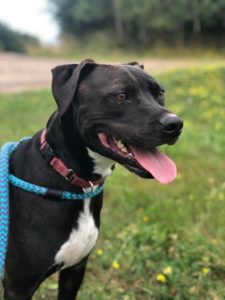
Jodi went into the shelter and told staff what she was looking for. The staff brought out a sweet black and white dog. That is the moment that Jodi met her future service dog, Cash, who had been found as a stray roaming around in Truro.

Jodi knew Cash was special when she met him. “From the minute he looked at me, he did something that a trained service dog does; he locked eyes with me and did not break eye contact. And he walked over to me and leaned against my leg and put his foot on mine, something a trained service dog does. Something that I had taught Sunshine,” says Jodi.

The Colchester SPCA staff worked to get Jodi approved quickly, and when she brought her son back to Dartmouth, she was able to bring Cash home with her in August 2022.

“Cash’s life story is a bit of a mystery,” says Jodi. “He’s originally from Texas where he was surrendered. Nobody knows how he got from Texas to roaming the streets of Truro. When I first got him, he wasn’t trained in any way and he was nervous of noise. He had absolutely no focus.”

But Cash’s life has completely changed since being adopted by Jodi. Thanks to Cash and Jodi’s hard work, he is now her service dog, trained to help with medical and mobility. “It took six or seven months for him to get his head squared away. He’s not noise nervous anymore. He has learned that rules stay the same and it’s something he can count on,” says Jodi.

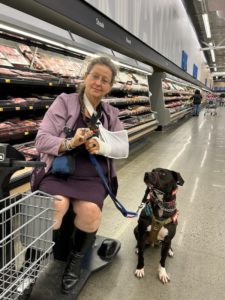
Cash has been given a life with purpose and he’s showered in love and care. He gets fed a healthy diet, sees the vet for check-ups often, and lives with Jodi and her other animals on a large property. He gets to travel everywhere with Jodi as her service animal, from doctor’s appointments, all the way to Ohio.

As much as Jodi has helped Cash, he helps her every day in return. Cash is trained to do many things, like help Jodi get up out of bed and chairs and help support her balance.

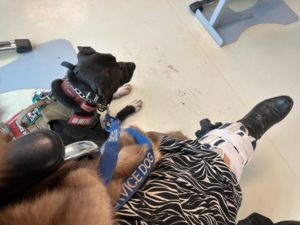
“Cash knows how to operate the buttons on cross walks and elevators and push the power buttons to exit or enter a building. He’s been on busses and he’s been to a Christmas Eve service and knows how to tuck under the seat,” says Jodi. “He loves opening doors. Especially those push bar ones. He smiles when he gets to push on those, and when he opens the door he goes out and uses his body to hold it open for me. The whole time he’s just so happy.”

When in public, Cash scans rooms and doorways, watches Jodi’s back, alerts her when someone is approaching and blocks them when needed. He is also trained to apply deep pressure therapy. Cash even protected Jodi when an intruder entered her home. He put himself in between the intruder and his owner and did not let them approach her.

“I’ve been through a lot and I have a hard time trusting people. When I’m out in public I’m struggling with that. Where Cash helps me is that I know he has my back. I know that he’ll step in and give me the space I need to reset myself. He’s going to make sure that I’m okay,” says Jodi. “He saves me everyday.”

It truly seems like fate brought Jodi and Cash together. “Cash has been a God send. I honestly believe that God led me to this dog, and him to me. He will spend the rest of his life with me and I am so grateful for him,” says Jodi.

And while Jodi needs Cash, she also just downright loves him. “He’s a 70-pound sookie that wants his own way,” she laughs. “He’s a lover and definitely not a fighter. He’s incredibly intelligent, he’s profoundly intuitive and he’s extremely patient. He has a sense of humour and he can be a total drama queen.”

Jodi encourages others to see the potential in dogs that need some love and training. “There are so many dogs in shelters that could be service animals. They don’t have to be perfect. Here’s my message: you can be broken, and still be awesome,” says Jodi.

If you’re considering adoption, click here to learn more and see some of the cuties available in our shelters.

Kirsten Millar

Kirsten is an animal lover and proud “dog aunt” who recently lost her two cats that she adopted from the SPCA in 2007. She volunteers at the SPCA to honour their memory and help other animals like them.

A True Undercat Story

By Taylor Huestis

When the odds are stacked up against someone, we’ll often refer to them as an underdog. They are expected to lose.

But one thing that people and pets have shown us is you should never underestimate an underdog.

Or an undercat.

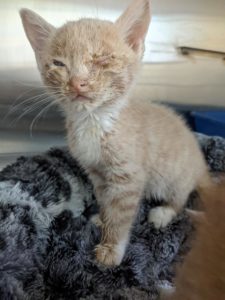
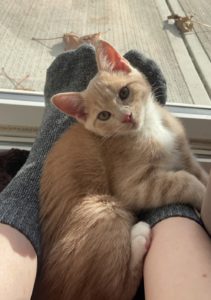
On September 6, 2023, two kitties were brought into the Kings SPCA. They had been abandoned on a working farm. At five weeks old, they should have been learning to play and explore. Instead, they were struggling to even see.

Sadly, these sick strays were suffering from Conjunctivitis. Their eyes were glued shut.

To help them heal, they were given veterinary treatment and went home with a loving foster family. The kittens were small in both size and weight – but they were full of courage and determination.

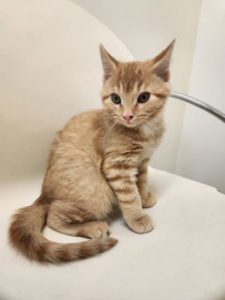
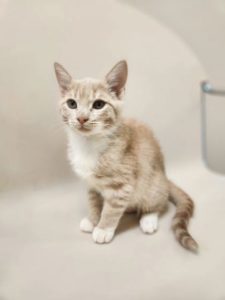
After months of supportive care, both kitties were medically cleared. To set them and their future families up for success, they were spayed/neutered thanks to our friends at PetSmart Charities of Canada. Because of the limited space at the shelter, they were brought to one of the SPCA’s offsite adoption partners: PetSmart New Minas.

Just like that, the kitties found families of their very own!

Dawson had been looking for a Siamese cat as he grew up loving the breed. Within minutes of meeting the two kitties, his heart had other plans.

“Turmeric ran up to the glass to sniff me and immediately he was meowing and purring,” Dawson remembered. “I had to hold him, and when I did, I knew he was the one I wanted, and I think he knew too.”

Only hours later, the same experience happened for Paprika.

“I missed having an animal in the house,” Gemma recalled. “Once she was in my arms she started purring and snuggled into me. So, I ended up bringing her home right there and then.”

Both spice kitties were able to put their past lives and shelter names behind them. Paprika was renamed Nala, and Turmeric now goes by Deku. In fact, he actually runs into any room when you say ‘Deki Deki Deku.’

They’ve experienced new things and learned fun tricks.

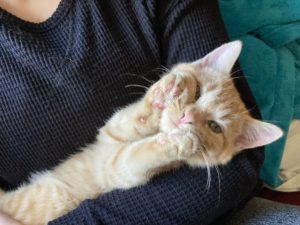
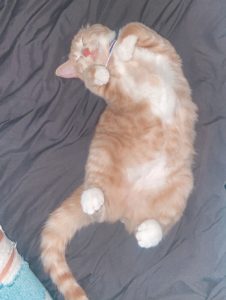
“We taught Deku to sit on our shoulder as we are walking around the house, like a parrot,” Dawson laughed. “He enjoys being around us and seeing what we are doing. He also loves toys like crinkle balls, springs, and anything with feathers and he has so much energy! Orange cat energy lol. Another fave memory is when he rode the roomba around the house!”

The same holds true for Nala. “Last week I had to drive from the valley down to a health clinic on Long Island and Nala loved the ferry ride across,” Gemma smiled. “She also has my partner wrapped around her paw, and we took her to the mall this week to pickup a cat tree (she picked out the biggest of course). Most places I go, Nala comes along too. She’s always by my side.”

These undercats came from humble beginnings. At first, they needed the SPCA to survive. Now, they’re helping their families thrive.

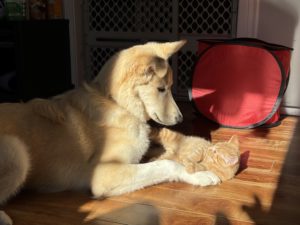
“Pets will always help my mental health and make my day better, especially in these winter months,” Dawson shared. “Also, one of our other pets, Neo, is quite a scaredy cat and having Deku around has got him out much more to play! Our puppy is a Pyrenees and is best friends with Deku and they sleep and play together. Deku is popular in our household.”

“Nala has been huge for my mental health,” Gemma explained. “Travelling between hospitals for work and clinicals, she’s become my road trip buddy and sleeps with me every night. She always gives me something to look forward to. And on my not so good days she’s there to snuggle too.”

With Deku and Nala, it’s easy to see why we root for the underdog and undercat. They deserve to be this happy.

Plus, after everything they’ve been through, it’s just so heartwarming to watch them win.

Taylor Huestis

Taylor is the Communications & Development Officer with the Nova Scotia SPCA and proud adoptive fur-parent to two cats named Bonnie and Boy (yep - that is his real name) and a palliative pup named Hazel. Connect with Taylor at thuestis@spcans.ca or 902-222-0378 today.

Buster the Feeding Tube Kitty Becomes a Mental Health Hero

By Taylor Huestis

Do pets realize they’ve been rescued? It’s a question we all ask ourselves.

Families will often share that their adopted dog, cat, or critter is the best pet they’ve ever known. Some say that pets seem to understand and love you all the more for it.

That certainly seems to be the case when it comes to Buster the kitty.

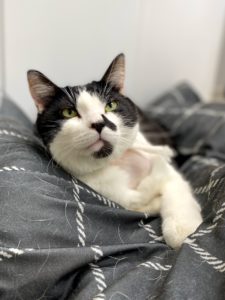
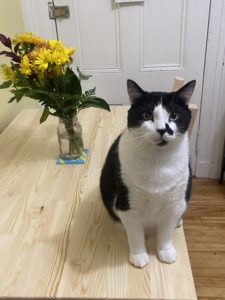
When Buster was first brought into the Dartmouth SPCA, he needed emergency care. One part of his recovery plan was a feeding tube to give medication and nourishment.

While Buster was recovering, he became the shelter cat who hung out in the office so he could be closely monitored. That’s when he locked eyes with Oliver, a dedicated animal care attendant.

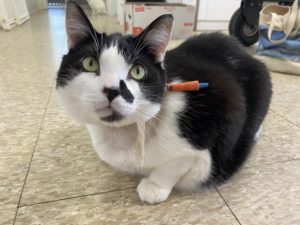
“The first time I met Buster was one of my first days working for the SPCA,” Oliver reflected. “While Buster spent a lot of his time in his bed (he was so sick, poor baby), he often sat by the door and greeted anyone who entered the lunchroom. While he usually plays aloof, he secretly loves to be loved (such a cat!) and he’d let you pet him when you came through the door.”

Because of the beautiful bond they formed, Oliver knew that they needed to be the one to adopt Buster.

“The day we brought Buster home, we opened the carrier door and he slowly and cautiously came out,” Oliver explained. “Since the first day he’s been loving and affectionate, but we’re really seeing his personality come out week by week. He’s started sleeping with us on the bed, and he’s usually by either mine or my partners side at all times. From day one he was a great fit, but the more time passes the more personality we see; it’s so rewarding and I feel so lucky to get to witness this emergence.”

And now, because Buster has made such strides in his recovery, he no longer needs a feeding tube! Buster has a healthy appetite and lots of energy to get into… antics.

“One wall of our apartment is a screen, and we set up the projector to watch a movie,” Oliver laughed. “While popcorn was popping and the kettle boiling, I put on a live bird feed to see his reaction to these 3 feet birds. He stared quizzical for a few moments, swung his tail but quickly got bored and curled up on the couch. I went into the kitchen to grab the snacks and there was a thud. Running back into the living room, I see Buster on his back legs, his top legs STUCK in the screen, having attacked the birds. I stopped laughing long enough to unhook him from the wall, and he proudly returned to the couch, having vanquished the birds.”

Buster makes Oliver and their partner laugh, but he is also supportive for the hard moments in life. Working in animal welfare is rewarding, but it is also emotionally taxing.

“The best Busty moments are those points when things aren’t going well, and you’re sad or scared or worried and he’s just there,” Oliver smiled. “You pet him and put your hands under his warmth and he head butts you and grooms your hair and makes biscuits: even though we don’t speak the same language, it just feels like he’s telling you everything is going to be okay.”

“He helps so much,” Oliver continued. “Just having that love come to me everyday when I get home, his little meow as soon as I come through the door, the feeling of him curling up at my feet during self-care nights, and the smell of his fur when I’m burnt out and trying to come down from a stressful, difficult day.”

Oliver helped Buster when he needed it, and now Buster shows his appreciation by helping Oliver.

“He’s a great listener, and I tell him all my issues and talk out so many problems,” shared Oliver. “Having him around, knowing that no matter how bad my day is going, he’s waiting at home has been so good for my mental health. Buster is just the best cat in the world.”

Taylor Huestis

Taylor is the Communications & Development Officer with the Nova Scotia SPCA and proud adoptive fur-parent to two cats named Bonnie and Boy (yep - that is his real name) and a palliative pup named Hazel. Connect with Taylor at thuestis@spcans.ca or 902-222-0378 today.