Special BFF

By Taylor Mundy

13-year-old Sweetpea was brought to safety at the Cape Breton SPCA. Extremely timid, the staff worked one-on-one with her to gain her trust and love.
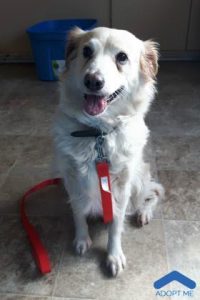
Sweetpea had some staining under her eyes and her ears desperately needed cleaning. She began medication right away to help her heal. A mammary tumor was discovered and was surgically removed before things got worse. Sweetpea slowly recovered and soon felt like a brand-new pup.

After nearly a month in our care, Sweetpea was medically cleared and ready for her forever family. It was love at first sight for Kara and Cory. They happily adopted Sweetpea and brought her home.

Then, this old doggo made a new friend.
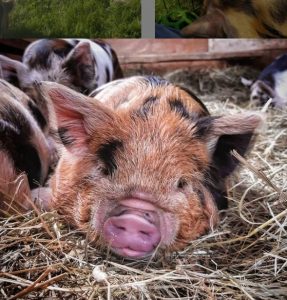
Kara and Cory temporarily farm sat in New Zealand. It was here that they got hooked on a whole different species altogether – Kunekune pigs. Covered in fur, very intelligent, and super social, Kunekune pigs are very similar to dogs.

Meatball, a 16-week-old Kunekune pig, captured their hearts. But would Meatball steal Sweetpea’s heart as well?
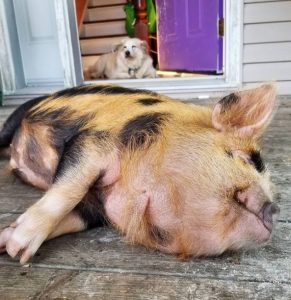
“At first, Sweetpea thought the pig was a bad guy,” says Kara. “She was worried that he was going to hurt us and his squeals were driving her crazy. She wanted to chase him so bad. But then she got to know him. Sweetpea is super smart and easy to train, so we really hoped they would be friends.”

Meatball joined the family and Sweetpea took him under her wing. “She now treats him like her baby,” laughs Kara. “When Meatball finishes his breakfasts and dinners, the first thing Sweetpea does is clean his face. She barks at cars that get too close to her pig, she’s super protective.”
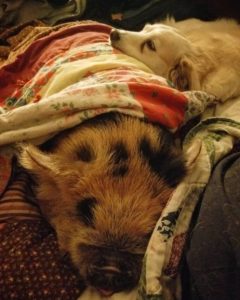
This unusual friendship is a treat to watch for Kara and Cory. “Meatball does everything Sweetpea does,” Kara explains. “We started trying to take them out for walks after work because he’s great on a leash! He walks like a dog beside her and we go out about one mile an hour because every person stops to say hi.”

The two might be an unlikely couple, but Sweetpea and Meatball have become the best of friends. “I don’t know it Sweetpea had puppies before we got her from the Nova Scotia SPCA, but she definitely has a motherly instinct,” says Kara. “They’ll lay down together and she’ll give him little smooches. They love strawberries and blankets, food and comfort. So they’re a match made in heaven.”

Despite their differences, Sweetpea and Meatball prove that friendship and love conquer all.


Feeling inspired? You can make more happily-ever-afters like this by donating to the Nova Scotia SPCA. Click here.
 

Taylor Mundy

Taylor is the Communications & Development Officer with the Nova Scotia SPCA and proud adoptive fur-mama to Bonnie and Clyde. She is passionate about raising awareness and funds for local animals in need.

Puppercycle

By Taylor Mundy

Passionate about his pooch and motorcycles, Steve creatively found a way to bring together his two favourite things.

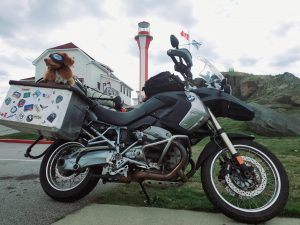
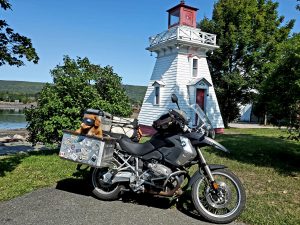
“I love hiking with my dog and I love my motorcycle,” explains Steve. “The struggle I always had was if the weather is nice do I go for a hike with the dog or ride my motorcycle? Combining the two seemed pretty natural.”

Steve picked up a trailer in British Columbia, customized it for safety, and invited his furry best friend for trips on the road.

Just like that, puppercycle was born.

“My old dog Bricklin spent a lot of time on the road with me,” Steve recalls. “Bricklin was a great learner and was comfortable anywhere. He was always just happy to be with me anywhere I went.”

“We used to road trip everywhere together. We often looked for the most out of the way, nonsense roadside attractions. Specifically, ‘world’s largest’ roadside attractions. It was always just an excuse to drive to new places across Canada and the US and often do big hikes and camping trips together.”

Then one day Steve brought home a new addition to the family – Datsun.

“Datsun immediately adopted all of Bricklin’s great characteristics,” Steve reminisces. “Last year was Datsun’s first motorcycle trip. Both dogs and I rode to Savannah, Georgia. Megan, my partner, flew down and the four of us came back together as a full family road trip across the Eastern Seaboard. This was for sure the best of many long-distance trips I’ve ever had.”

Sadly, Bricklin passed early this year at a very ripe old age after a good life. “He lives on in Datsun,” says Steve.

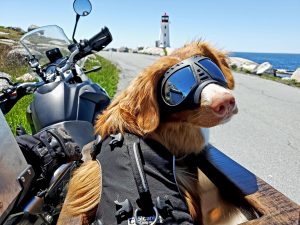
Now a duo, Steve was determined to have Datsun closer to him while riding. “COVID lockdown was tough on all of us but I had some extra time,” Steve explains. He began building the Datsun Box and tested out different models to make sure Datsun would be comfortable and safe.

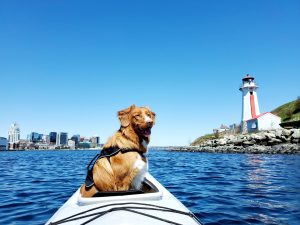
Normally a long-distance rider, all travel plans were cancelled due to the pandemic. Steve and Datsun decided to do the most Nova Scotia thing they could. They googled where all the lighthouses were in the province and set an arbitrary goal to visit every lighthouse in Nova Scotia – together.

“Datsun and I have now put more miles on two wheels this year than I have ever done on any of my big trip years,” laughs Steve. Many lighthouses are on islands and require kayaking so Steve got a 19-foot dual kayak for him and Datsun.

They have almost hit their goal. In fact, they have visited 124 lighthouses so far and traveled on nearly every road in Nova Scotia.

And Datsun? He can’t get enough. “He treats the bike with the same excitement as a normal dog gets for a car ride.”

“Every time I see a new part of Nova Scotia, I come home saying that it’s my new favourite,” Steve says. “I don’t think I ever realized how much I like my home until I started all this. This has unexpectedly been the best motorcycle year of my life rediscovering Nova Scotia.”


Seeing how happy Datsun and Steve are on their adventures together is truly heart-warming and inspiring.

Pets are so special. They make us laugh. And comfort us. They give unconditional love.

If you have a pet who brings you joy or has left paw prints in your heart, please donate to the Nova Scotia SPCA to help pets who are waiting for their furever friend.


Taylor Mundy

Taylor is the Communications & Development Officer with the Nova Scotia SPCA and proud adoptive fur-mama to Bonnie and Clyde. She is passionate about raising awareness and funds for local animals in need.

Three Special-Needs Kittens Find a Special Mom

By Judy Layne

There are special people in this world.  People with big hearts willing to step up to give homeless animals with special needs a loving home and a second chance at the happiness they deserve.  Lorelea Chandler is one of those people.

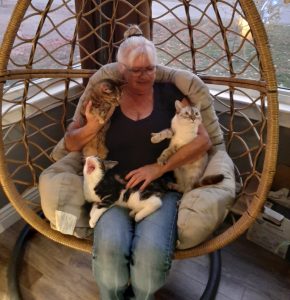
Lorelea and her husband Charlie MacKeen had been quietly saving stray cats for years. They dedicated their time without fanfare or publicity. Four years ago, they adopted a kitten with Cerebellar hypoplasia and since then, two more kittens with the disorder have found their way into their heart and home.

Cerebellar hypoplasia (CH) is a neurological condition in animals where the cerebellum of the brain doesn’t develop properly. It ranges in severity from a minor wobble in an animal’s walk to extreme difficulty moving around.  Kittens with CH require special families to adopt them that will be patient and understanding of their physical challenges. Some folks may not be up for this, but Lorelea was – three times! Count ‘em – cuties Ava, Betty and Collins – all from the SPCA Kings Shelter. 

Lorelea relates “I wasn’t looking to adopt any special needs kittens since we already had two older cats at home.  Ava, our first adorable CH kitten literally landed in my lap in 2016 through my granddaughter’s urging.”  This June, Lorelea heard about kitten Betty with CH on the radio.  “I just had to call about her and when I went to see her, I fell in love at first sight and brought her home,” she explains.  And Collins?  Lorelea shares “I have a friend that works at the Kings Shelter and she messaged me in September saying they had another kitten with CH.  I told her that we already have 3 cats and my hubby would kill me if I adopted another CH kitten.  But I mentioned Collins to Charlie and he good-naturedly said to bring him home.”

The 3 kittens span the spectrum of CH symptoms.  “Betty is the least affected. She can almost walk, run and play like a normal cat,” reports Lorelea.  “She does have some eyesight problems, seeming to chase things that aren’t always there.”  Ava is the most affected by CH.  “She has difficulty navigating stairs and can’t go more than a few feet before stumbling. She can’t jump like a normal cat, but she’s adapted by pulling herself up with her front legs if she wants to climb.  She also has tremors when she’s excited,” Lorelea explains.  Collins is somewhere in between.  “He wobbles and has tremors when he’s tired or has just woken up.  He’s full of mischief, playfully jumping on Betty’s back which Betty doesn’t mind at all,” chuckles Lorelea.  “Our older cat Dicky gets along great with the kittens; he’s just like a mother hen!” she laughs.

CH kitties aren’t defined by their limitations.  What they may lack in coordination, they definitely make up for in determination.  Case in point, Ava. “One day, I was outside with Ava (closely supervised by me) and chatting with a friend,” relates Lorelea.  “We suddenly saw Ava walking slowly up the front steps!  I got behind her to make sure she didn’t fall and let her go for it.  When she reached the top, the look on her face was priceless – it was like ‘Hey mom, did you see what I just did?!’  I was so proud of her.”

“There are so many happy moments with the kittens and they are a true source of inspiration,” says Lorelea.  While many people may overlook homeless pets with special needs in search of the ‘perfect pet’ Lorelea looks at it this way………… “I find animals and people are a lot alike.  We all have certain needs and there are some things we can and cannot do.  The kittens may not be able to do some things like cats without CH, but I let them try as long as there is no danger of them getting hurt.  As for me, I can’t sing or dance, but I try anyway!”

And Lorelea’s advice to anyone considering adopting a special needs pet? “You won’t see a special needs pet; you’ll see a pet that needs love.  They deserve a chance to show you how awesome they are and you’ll be rewarded by unconditional love and gratitude.”


Understanding the commitment involved in adopting a special needs pet is crucial to a happy healthy relationship. There are important things to consider before adopting a pet with special needs.

  • Think about any long-term dietary requirements, special medications or treatments your pet will need. Pets with behavioral issues may need special training; those with mobility challenges may need therapy or surgery.  Ensure you can fit these costs into your family’s budget. 
  • Your pet may need medications/injections at specific times of day. Ensure you’re available to do this.
  • Talk with your family about the challenges that come with adopting a special needs pet and ensure everyone’s onboard.
  • Your pet may need more frequent vet visits. Pets with an injury or physical disability may need assistance with standing or walking. Some may need you to physically accompany them outside for bathroom breaks, as opposed to simply being let out. 

The Nova Scotia SPCA makes every effort to place special needs pets with their perfect human match.  Before deciding to adopt, speak to shelter staff since they’re familiar with the animal and consult with your vet to get a good understanding of the pet’s ongoing requirements.  Whatever the pet’s special needs, the SPCA will be there before and after adopting to support you by providing information and advice.


Judy Layne

Judy is a dedicated volunteer with the Nova Scotia SPCA and proud adoptive fur-mama to Gracie. She is committed to speaking for animals who cannot speak for themselves.

It’s Time to Celebrate Our Furry Feline Friends

By Judy Layne

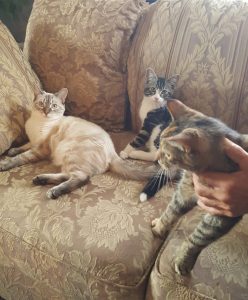
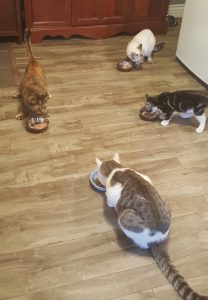
Charles Dickens said “What greater gift than the love of a cat?”  Those of us with feline family members would agree.  We know that life just isn’t the same without a cat in it! We have the privilege of enjoying the companionship and unconditional love our kitties bestow upon us all year long. November has been designated as Cat Appreciation Month to encourage cat lovers to celebrate the kitties in their life, but as well, to draw public attention to the large number of cats that are waiting in shelters and rescues to find their forever homes and that special someone to love them.

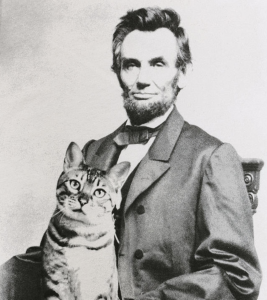
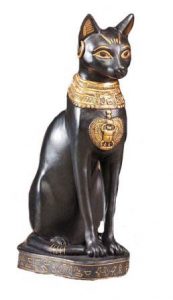
Whether you’re a cat person or not, there’s a certain appreciation you have to have for cats and their long history within civilizations. Cats have been a part of our culture and home lives since ancient Egyptian times.  There have been many famous cats throughout history – from presidential felines like Abe Lincoln’s cat Tabby and Bill Clinton’s cat Socks to internet stars like Grumpy Cat.

But it’s the everyday cats that bring magic and joy to our lives.  It’s a rare day when I don’t think about how grateful I am for the amazing adopted kitties in my life.  They are more than pets; they are family members.  Cat Appreciation Month is a purr-fect opportunity for me to share some of the reasons I value my cats.  They make me smile and laugh at their goofy antics.  They’re great listeners and love to chat.  They’re always available to cuddle, to warm my lap and bed, and to donate their services as alarm clocks! They make a windowsill more beautiful.  They’ve taught me important life lessons: the value of opening your heart to nurture others, how to move through fear or hard times and land on your feet, how to appreciate the ordinary and dare to interpret it as extraordinary, as only cats do. They’ve inspired me to do more, to give more and to be more when it comes to animal welfare.  And they’ve taught me how to cope with grief and let go.

Why are YOU thankful for the cats in your life?  If you have a kitty who brightens your life, makes you laugh and adores you unconditionally, share their story and photo with others on the SPCA’s Facebook page:


Here are some great ways to celebrate Cat Appreciation Month. 

For your own kitty:

  • spoil them with a new fun toy, bed or treats
  • make a comfy window perch for them to enjoy the sunshine
  • give them a soothing brushing or massage

For all the homeless kitties out there:


The Nova Scotia SPCA believes that every cat deserves a forever home where they are safe, warm, loved and treated as family – in short, appreciated.  Every year, over 4,000 homeless cats cross the SPCA’s doorway in need of help and looking for love.

Being a cat parent is a precious gift and a responsibility that should never be taken lightly.  Please ensure you can properly care for a cat before opening your heart and home.


Judy Layne

Judy is a dedicated volunteer with the Nova Scotia SPCA and proud adoptive fur-mama to Gracie. She is committed to speaking for animals who cannot speak for themselves.

From Having to Hoarding

By Judy Layne

You know what you’re going to find on the other side of the door.  No matter how many times you’ve seen it, it’s still shocking.  The first thing to hit you is the smell – acrid ammonia that burns your eyes and assails your nose even through a respirator.  The windows are covered but even in poor lighting, you see that cats are everywhere – in cupboards, sinks, atop and under furniture. Your feet stick to urine on the floor and feces is scattered throughout the house.  It’s hard to move among the clutter and bags of garbage.

 You’re there to help but to the cats, you’re frightening intruders in hazmat suits.  They scatter and hide as you try to capture them and transport them to safety at the Nova Scotia SPCA. 


Hoarding cases like this happen all too often in Nova Scotia.  Yet, due to the nature of animal hoarding, countless cases remain undetected and unreported. A complex disorder, it affects both animal and human welfare.

Not everyone who has multiple animals is a hoarder.  Many people are capable of providing appropriate care for numerous animals. The following criteria are used to define animal hoarding:

  • possession of numerous companion animals
  • failure to provide minimal standards of nutrition, sanitation, space and veterinary care, with this neglect often resulting in starvation, illness and death
  • denial or inability to recognize the impact of this failure on the welfare of animals and humans in the household.

Most hoarders start with good intentions, a kind heart and a few unspayed/unneutered animals.  As the number of animals multiply, they become overwhelmed and end up inadvertently inflicting cruelty when their care cannot keep pace with the number of animals they have.  Hoarders may insist that their animals are happy and healthy, even when there are clear signs of distress and illness.

Why do people hoard animals? Research indicates that the compulsion to hoard often comes from a change in someone’s life – a loved one’s passing, health issues, loss of a job. Some studies show a recurring theme of neglect or loss in childhood.  Hoarders may be socially withdrawn and isolated, turning to animals for love.

The majority of animals seized from hoarding situations need medical attention.  Most require vaccinations and spaying/neutering.  Overcrowded dirty conditions make for easy transmission of lice, fleas, mites, and infections. Accumulated feces and urine can burn skin, eyes and lungs. Many animals are malnourished and dehydrated, requiring extensive dental work. Animals must often spend weeks in the SPCA’s care until they are healthy enough to be adopted. Euthanasia is a harsh reality for any animal whose health is beyond help.

Hoarding also impacts human health.  Close quarters common in hoarding facilitates the transmission of disease from animals to humans in the home, with children and the elderly more at risk.

Family, close friends and neighbors are often the first to see the neglect in its early stages, but often misunderstand it and don’t report it until conditions become tragic. Increasing public awareness and early intervention are key to addressing the problem of animal hoarding.

Each of us plays an important role in stopping animal hoarding.  First and foremost, spay and neuter your pets early.  Know your limits concerning space, time and finances in caring for pets. If you think someone is struggling with animal hoarding or if you suspect or witness animal neglect or cruelty, call the SPCA (toll-free: 1-888-703-7722; local 902-835-4798) or file a confidential online complaint here.  If you recognize that you yourself are struggling with hoarding, please do the right thing and reach out early for help to the SPCA.

Let’s work together to stop the act of having before it turns to hoarding.


Need your pet fixed? Our Low-Cost Spay & Neuter Program services help low-income families fix their pet. Click here.

Find yourself with many new sets of tiny paws? Accidents happen. We can help! Click here.


Judy Layne

Judy is a dedicated volunteer with the Nova Scotia SPCA and proud adoptive fur-mama to Gracie. She is committed to speaking for animals who cannot speak for themselves.

From Heartbreak to Happily-Ever-After

By Judy Layne

June 16th, 2019 was a dark day even though the sun was shining bright. That’s the day that someone perpetrated a malicious, senseless act of cruelty on an innocent cat – Phoebe.  Many of you may remember Phoebe’s heartbreaking story; we know you will be thrilled to read about her happily-ever-after.

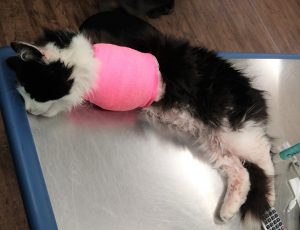
That dark day, SPCA Cruelty Officers responded to an emergency call and rescued an injured black and white cat on Gillis Lane in Dominion, Cape Breton. It was clear that Phoebe’s leg was broken but x-ray scans showed that the trauma was much worse. Phoebe had been shot with a .22 caliber gun. The bullet went through her back leg into her front leg, shattering the bone.

Phoebe was rushed into emergency surgery at the SPCA Cape Breton Animal Hospital where, sadly, her front leg had to be medically amputated to prevent a lifetime of discomfort.  Over the next few weeks, Phoebe recovered under close medical supervision by the shelter’s veterinary team.  Staff and volunteers alike worked hard to re-build Phoebe’s trust of human beings as they showered her with love and attention.  Her sweet personality was emerging more and more every day. Slowly, she started to adjust to life with only three legs.

Phoebe’s complicated surgery was a huge undertaking for the Cape Breton SPCA because the SPCA does not receive any government funding for their shelters.  Her case touched many people’s hearts. The community of Cape Breton and animal lovers throughout Canada and beyond came together to help Phoebe and the SPCA is truly grateful for their compassionate support.

The very day that Phoebe was medically cleared for adoption, she found the purr-fect forever family!  Kelly MacKinnon and her partner Ethan Black had been following Phoebe’s journey and had already contacted their veterinarian to learn how to care for a pet missing a leg in case they were the lucky ones to adopt her.  Kelly shared “When we saw Phoebe’s story on Facebook, we instantly fell in love and wanted to adopt her.  We were drawn to her bright eyes and sweet face and were inspired by her strength and bravery.  We knew she needed a special home filled with patience, love and attention.  We wanted to give her the life she deserves, away from the cruel thing that happened to her.”

“Phoebe adapted nicely to her new home,” reported Kelly.  “There haven’t been too many challenges with her amputation, but we did start arthritis prevention immediately.” And the lack of a leg hasn’t slowed Phoebe down. “She creates her own make-shift staircases to get where she wants to go. One night shortly after we brought her home, she went into the closet and when we looked up, she was walking across the hangers. Since then, we keep closets closed as we worry about her falling,” said Ethan.

Phoebe is absolutely spoiled with lots of toys, beds, and yummy treats. She even has a fur-sister, Jane, who was also adopted from the Cape Breton SPCA. “Jane and Phoebe get along well and play often. They love being outside in nice weather in their special ‘catio’ where they can be safe while lounging in the sun for a nap,” stated Kelly.

“We constantly marvel at Phoebe’s bravery,” said the couple.  “We would encourage anyone thinking about adopting a special needs pet to do so if they can! It’s tremendously rewarding – they teach us about strength and resilience and every day with them is better than the day before.”

Phoebe found a family who truly loves her. She learned that people can be loving and kind. If you’re reading this, you must be one of the good ones. You can help abandoned and abused pets like Phoebe to put their painful past behind them and give them a happy and healthy future.

Be a hero and donate today to help the next pet in need.


The person who did this to poor Phoebe has not been found to date, so the SPCA still needs your help to fight for justice. They hope that the passage of time will encourage someone to come forward with what they know – it’s never too late to do the right thing and the smallest piece of information may be just what is needed to advance the investigation.  Anyone who has any information, or who may have witnessed the incident, is urged to call the SPCA’s confidential toll-free hotline at 1-888-703-7722, e-mail animals@spcans.ca or fill out the online form here.


Judy Layne

Judy is a dedicated volunteer with the Nova Scotia SPCA and proud adoptive fur-mama to Gracie. She is committed to speaking for animals who cannot speak for themselves.