REALTOR® to the Rescue

By Taylor Mundy

Fetching your dream home and looking for your purrrrfect realtor?  Check out Nicole Pittman at Royal LePage Atlantic.  Since joining in 2015, Nicole has raised more than $10,000 for the Nova Scotia SPCA.  Yep, you read that right… $10,000 to help care for SPCA shelter pets!  We are so grateful for her support and 10,000 thank-yous would never be enough.  So, to celebrate an amazing milestone, we’re sharing our top 3 reasons why we love Nicole and Pawsitive Properties!

#1 – LOCAL BUSINESS HELPING LOCAL ANIMALS

This amazing initiative kicked off in Atlantic Canada!  Originating in New Brunswick by Jessie Yerxa with Exit Realty, Pawsitive Properties helps to find homes for both pets and people.  Anytime a house is sold or purchased through Nicole Pittman, a generous donation of $100 is made to help furry friends in need.

“I had always wanted to do something with animals but found myself on a different career path, so I thought this would be a great way to incorporate something I am passionate about with a career I love,” says Nicole.  “My favourite thing about real estate is the connections I make with my clients.  I have formed many friendships by helping my clients sell or buy their homes.  Many of my clients are also animal lovers and they love the fact that when they work with me, they are also helping animals at the SPCA.”

#2 – FUR-EVER HOMES

Pets are more than just furry besties – they’re family!  Growing up, Nicole experienced this first hand.  She explains, “I’ve always had multiple animals.  I truly feel a house becomes a home when you are greeted with a wagging tail or a welcoming meow.”

Every time Nicole drops off her generous donations, she makes sure to come in and give our adorable adoptables some TLC.  “I love my visits to the Dartmouth shelter; the staff are so wonderful!  I always try to get a kitty snuggle or a walk with whoever the staff thinks could use it.”

#3 – MAKING A DIFFERENCE

Last year over 6,000 animals were re-homed throughout the province.  Where the Nova Scotia SPCA does not receive any government funding for our shelters, community support is critical to our future.  Generous donations provide the means to help rescue, rehabilitate and rehome animals in need.

Helping local pets is Nicole’s main motivation.  “My favourite part of the Pawsitive Property campaign is knowing I am helping so many animals that truly need it,” says Nicole.  “My favourite memory of this journey so far would be my first donation day.  It was the start of something that I knew would be so personally fulfilling and I know I will look forward to each donation day for years to come.”

Well Nicole, we could go on with 10,000 more reasons why we love you and Pawsitive Properties, but we’ll cap it there.  Thank you for helping our SPCA shelter pets along their journey to find fur-ever homes!

* If you are interested in connecting with Nicole Pittman at Royal LePage Atlantic, she can be best reached at 902-430-2054 or nicolepittman@royallepage.ca *

Taylor Mundy

Taylor is the Communications & Development Officer with the Nova Scotia SPCA and proud adoptive fur-mama to Bonnie. She is passionate about raising awareness and funds for local animals in need.

WOOF is a Definite Win-Win

By Judy Layne

Looks – check.  Personality – check.  Brains – check.  Some guys just seem to have it all.  Enter one Marty McFly, the top graduate of the class of 2016.  No easy feat since Marty was only 8 weeks old!  In fact, all of Marty’s fellow classmates were just 6 – 10 weeks old too.  So what’s the scoop? 

These proud graduates were actually cute canines who participated in the WOOF (Working on Our Futures) Program.  The program is a joint initiative between the NS SPCA and the Department of Justice and operates at the Central Nova Scotia Correctional Facility in Burnside.  Through the program, Amy MacRae, an SPCA dog expert, teaches inmates how to train the puppies so that they are adoption-ready.  Launched in 2012, WOOF is now a proud fixture at the facility.  An amazing 680 puppies have participated in WOOF to-date!

When puppies arrive at the SPCA Dartmouth Shelter, they stay for 2-3 days for a general health assessment, needed treatments and vaccinations.  They are then transferred to WOOF and live on-site at the facility.  They have their own space for sleeping and during the day, they’re paired with inmates for training.  Puppies are never left alone, as correctional officers are always supervising. Inmates are carefully screened and those with a history of domestic abuse or violence are not eligible to participate. The SPCA covers all needed medical and care costs. At 8 weeks old, puppies are spayed/neutered and are available for adoption within a few days.

WOOF has won national awards and is a great example of a government-SPCA partnership in which a little money and a lot of creativity yield win-win solutions.  For inmates, it’s an opportunity learn responsibility, how to show respect, patience, care and love for an animal – skills that can help them change the direction of their lives.  An unnamed inmate summed it up perfectly – “The puppies appreciate what we’re teaching them and we appreciate what they’re teaching us.”

Being in the program is deemed a privilege and acts as an incentive for good behaviour for many inmates.  Correctional officers report that the presence of puppies in the facility helps reduce tension, brings a sense of calm and strengthens the relationship between staff and inmates.  In short, WOOF creates a better, safer place to work. WOOF is also helping to make communities safer, providing offenders with an opportunity to become contributing members of society.

For the NS SPCA, Amy says that “WOOF helps to relieve pressure on their shelters, opening up kennel space for the organization to help more animals.”  For the puppies themselves, she states that, “receiving the care and socialization they need helps to ensure they get good homes.”

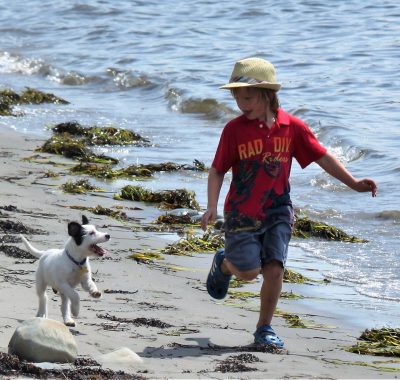
And who better to ask what benefits WOOF offers to potential adopters than Marty McFly’s adoptive mom, Shelly Malcolm Beazley?  In August 2016 when Shelly’s family was ready to adopt a dog, she reached out to Amy to find the right puppy who fit with their active household.  “When I saw Marty’s photo, I just knew we had to meet him,” says Shelly.  The family was drawn to Marty’s playful, kind nature (not to mention his cuteness factor).  “A Jack Russell mix, he was sized well for us and had the perfect energy to keep up with our active lifestyle.”  Shelly shares that, “Because of WOOF, Marty came to us well socialized and was immediately at ease being handled and around people.” Two-and-a-half years later, Marty has become the ‘official CEO of Happiness’ at Shelly’s workplace, Cove Sport Therapy.  “He greets clients and never fails to brighten their day, adding snuggles to their therapy appointment,” relates Shelly.  “He’s become quite famous in his role, approached regularly while out and about in the community.  It’s not uncommon for people without an appointment to stop in just for a few Marty cuddles.”

I’m sure you’ll join me in giving two paws up to everyone who makes the WOOF Program a winner!

Judy Layne

Judy is a dedicated volunteer with the Nova Scotia SPCA and proud adoptive fur-mama to Gracie. She is committed to speaking for animals who cannot speak for themselves.

8 Important Reasons to Spay/Neuter Your Pet

By Judy Layne

Spaying/neutering your pet is one of the most important things you can do to ensure your pet will lead a healthy happy life. It is also the most effective and humane means of decreasing the number of homeless animals and saving lives.  Today is World Spay Day, a global occasion designed to shine a spotlight on the importance of spaying/neutering companion animals and feral/stray cats.

Here are 8 important reasons to spay/neuter your pet.

  1. Your pet will live longer.  Studies show that, on average, the lifespan for spayed/neutered pets increases by 1-3 years (dogs) and 3-5 years (cats).
  2. Spaying offers health benefits to your female pet. Spaying eliminates the risk of ovarian/uterine cancers and life-threatening uterine infections. It also lessens the risk of breast cancer, in 90% of cats and 50% of dogs. Spaying your pet at about five months before their first heat provides the best protection from these diseases.
  3. Your spayed female won’t go into heat.  Female cats normally go into heat every 3 weeks between January and November.  Unspayed, they may howl relentlessly, escape the house to find a mate, or urinate inappropriately.  Female dogs normally go into heat twice a year. Unspayed, they may display unwanted behaviors including aggression.
  4. Neutering provides health benefits to your male pet.  If done before six months of age, neutering eliminates the risk of testicular cancer in dogs and cats. It also reduces the risk of prostate troubles in dogs.
  5. Your neutered male won’t wander.  Unaltered males will do almost anything to find a mate, including bolting out the door and digging under the fence.  Once they roam, they’re at risk of injury/death from traffic, fights with other dogs, becoming lost or stolen.  Unaltered male cats are at risk of contracting deadly diseases like feline leukemia.
  6. Your neutered male will behave better.  Neutered pets centre their interest on their human families.  They are less frustrated, calmer and less apt to bite or get into fights.  They also lose the desire to mark their territory by spraying urine in the house.
  7. Spaying/neutering your pet is cost-effective.  The cost of spay/neuter surgery is relatively small when compared with the health and behavioral benefits your pet will attain, and it helps to avoid expensive serious health problems in the future. It is also much less than the cost of having a litter – prenatal care, birth complications, food and puppy/kitten care.
  8. Spaying and neutering helps battle pet overpopulation. Each year, thousands of homeless animals end up in shelters and rescues across Nova Scotia. Pet overpopulation is a direct outcome of unplanned unwanted litters that could have been prevented by spaying/neutering.  Every pet owner has an important role to play in preventing pet overpopulation.

Many pet owners don’t realize that ‘babies’ can have babies of their own.  Female dogs can breed as early as six months old; cats as early as four months old. Pets also reproduce at alarmingly fast rates. In 7 years, one unspayed female dog and her offspring can produce 99,000 dogs.  In the same timeframe, one unspayed female cat and her offspring can produce 420,000 cats! Question: How does one person save thousands of homeless animals?  Answer:  Just spay/neuter one.

Thanks to PetSmart Charities of Canada’s support, the Nova Scotia SPCA is leading the fight against pet overpopulation.  Check out:

As a responsible pet owner, please spay or neuter your pet.  Do it now as spring and summer breeding season is just around the corner.  Reducing pet overpopulation begins with you, so please ‘spay it forward.’ Together, we can help end the suffering.

Judy Layne

Judy is a dedicated volunteer with the Nova Scotia SPCA and proud adoptive fur-mama to Gracie. She is committed to speaking for animals who cannot speak for themselves.

Healthy Teeth Make for Healthy Pets

By Judy Layne

Good dental hygiene is just as important for pets as it is for people.  If in doubt, imagine how your teeth would look and feel if you didn’t brush them for weeks or even years!  Your pet’s teeth are no different.  Unless you regularly provide some form of dental care, you’re ignoring a vital part of your pet’s overall health.

Gum (periodontal) disease is by far the most common health problem of cats and dogs.  According to the American Veterinary Dental Society, by the time they are 3 years old, more than 70% of cats and 80% of dogs show early signs of the disease, which will worsen as the pet grows older if preventive measures aren’t taken.

Gum disease starts when bacteria combines with food to form plaque on teeth. Initially plaque is soft, so brushing or chewing kibble and toys can dislodge it. Plaque soon hardens to form tartar and if ignored can lead to inflamed swollen gums that bleed easily. Tartar above the gum-line can be seen and removed, but tartar below the gum-line is harmful and may lead to damage to teeth, jawbone and surrounding tissues. This is very painful for your pet, but the good news is that these issues can be prevented before they start with proper dental care.

Open wide!

Gum disease doesn’t just affect your pet’s mouth. Advanced gum disease can have serious impacts on your pet’s heart, kidneys and liver.  Pets are good at hiding pain; you may not know that your pet has a serious problem until it’s too late. That’s why it’s crucial to take your pet in for regular dental checkups and professional cleanings.

Regularly brushing your pet’s teeth at home is the best thing you can do to keep your pet’s mouth healthy between professional cleanings by your vet and may lengthen the intervals between those cleanings. Most dogs accept brushing, while cats can be a bit more resistant, so patience is key. Start out gradually for a minute at a time, using flavored toothpaste specifically made for cats and dogs, treats and lots of praise so your pet associates brushing with something positive.  Use a child’s toothbrush or finger brush and never use human toothpaste. The web has many helpful videos about brushing your pet’s teeth. Brushing at least once a week is recommended. Don’t try brushing for the first time if your pet’s gums are red or inflamed – visit your vet for an assessment.

Your pet’s teeth should be checked at least once a year by your vet.  Visit your vet sooner if you observe any of the following problems:

  • bad breath
  • teeth that are discolored or covered in tartar
  • broken or loose teeth
  • difficulty chewing, dropping food from the mouth or drooling
  • reduced appetite or refusal to eat
  • pawing at the mouth
  • pain or swelling in or around the mouth
  • bleeding from the mouth.

Always be careful when checking your pet’s mouth, because an animal in pain may bite.

Aside from regular brushing and professional cleaning, your vet may recommend a plaque prevention product and/or switching to a dental diet designed to improve bad breath and prevent plaque and tartar build-up.  Certain treats and toys also promote good oral health. Good dental care, both at home and at your vet, plays a key role in helping your pet live a longer, healthier life.

Judy Layne

Judy is a dedicated volunteer with the Nova Scotia SPCA and proud adoptive fur-mama to Gracie. She is committed to speaking for animals who cannot speak for themselves.

Leaving Love Behind: Tanner’s Tale

By Judy Layne

His family said goodbye and he watched as they went out the door and drove away.  He waited excitedly by the window for them to return.  He sat there for many hours.  He looked anxiously at every passing car, hoping to see them.  He grew hungry and thirsty, but his food and water dishes were empty.  It got dark outside and there were no lights on in the house; he became afraid.  Days passed and his family still didn’t return.  He wondered if he had done something wrong. He wondered if his family didn’t love him any longer. How could that be?  They had promised to take care of him for a lifetime. Lonely, scared and cold, he tried to find food, but there was none.  After a week, his legs grew tired and he couldn’t get up any longer.  His eyes lost the sparkle they always had. 

Just when his strength was ebbing away, the door opened and the couple who had bought the house from his family entered.  They were shocked to find a sweet cat in acute distress. They gave him food and water he so desperately needed and they tried to comfort him.  They would have loved to keep him, but the wife was allergic to cats.  So they took him to the NS SPCA Colchester Shelter.  He was safe now. 

He had no name, so the Shelter staff named him Tanner.  When he arrived in April, 6-year old Tanner was severely emaciated, had ear mites, fleas and a grade 2 heart murmur He received necessary medical care, along with love and attention from the staff.

Ketrina Harnish-Keating and her partner Ryan Turnbull had lost their precious adopted cat Tobi Jackson to a brain tumor.  In June, they visited the Colchester Shelter and were drawn to Tanner.  “He had the most beautiful amber eyes”, says Ketrina.  “He was sitting in a corner and looked so sad.  The two of us had an instant connection and it didn’t take much to convince Ryan to bring him home.  A few eyelash flutters and pouts did the trick.”

Tanner was skittish in his new home for a few days, but then settled right in.  Ryan relates that “initially, we gave him lots of space and let him come to us for the most part.”  As for Tanner’s favorite things, Ryan says “Looking out the big window in the living room for hours. Cuddling into mom’s or dad’s neck and wearing the new bandana we bought him for Christmas. And lots of treats!” He now has a baby cat-sister, Temmie, that the couple adopted last fall.  “It took some time and patience, but they’re good friends now; we find them playing or curled up together.”

The most surprising thing about Tanner is how amazing he is with children.  “I work at a daycare and he’s come to work with me for full days”, Katrina states.  “The children love him and he’s very gentle with them. The 5-10 year olds in the after-school program feed Tanner, brush and play with him, and clean his litter box.  It’s a great way to teach kids responsibility.”

Luckily Tanner’s story had a happy ending.  Not all abandoned animals are so fortunate.  Last year alone, the Nova Scotia SPCA investigated 89 cases of abandonment.  There is NEVER a good reason to abandon your pet when there are other safe alternatives available.  Ketrina’s advice?  “Pets are totally dependent on us.  It’s heartbreaking to think of the trauma that an abandoned pet must endure.  Take them to the SPCA where they will be cared for while they wait for a loving home.”  The couple’s final thoughts?  “The SPCA has been everything to Tanner.  They nursed him back to health, and gave him the love, care and attention he so desperately needed after he was abandoned. The NS SPCA is important to the community, animals and families they serve.  We’re disheartened to think where the animals they care for would be without them.”

Judy Layne

Judy is a dedicated volunteer with the Nova Scotia SPCA and proud adoptive fur-mama to Gracie. She is committed to speaking for animals who cannot speak for themselves.

Building A Bridge Of Trust

By Judy Layne

Imagine yourself standing before a swinging rope bridge that crosses a deep ravine.  You look down and your heart leaps into your throat.  A stranger on the other side encourages you to cross, telling you it’s safe.  They hold out their hand and say you can trust them.  But fear makes it hard to take that first step.  

And so it goes with some homeless animals whose lives have not been filled with the care, love and attention that they deserve.  Their fear is often greater than their hope of finding love. We need to build a bridge of trust between what was and what can be before an animal can take their first steps towards a new life.

Take Roy for example.  The handsome 5-year old Rotti-Shepherd mix was surrendered in August 2018 to the NS SPCA Cape Breton Shelter by owners who were not able to care for him adequately.  Physically, Roy was in good health, but emotionally, he was fragile.  He was disengaged, depressed and very frightened. It took Roy several days to allow staff to interact with him. He was afraid of sudden movements and cowered or hid when anyone new was present.  Very food-motivated, treats were often the only way for staff to get close to him.

Roy needed much patience, time and love.  Shelter staff devoted extra time daily to socializing him and helping him gain confidence.  It took several weeks, but Roy learned to trust them.  Little by little, he was becoming braver but was still terrified of new people.  Then in November, Sheilah MacDonald visited the shelter and Roy’s life changed.

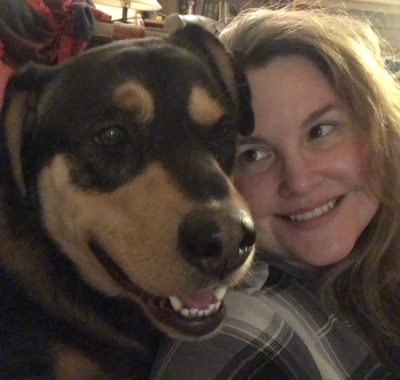
Sheilah had lost her sweet Rotti Oscar to cancer in October, and while she knew she’d get another dog someday, she was in no rush.  One day she decided to stop in to the SPCA to ‘just see’.  When she was introduced to Roy, the sight of his big paws melted her heart.  “The poor boy hugged the wall, moved slowly and when he saw me, his tail went between his legs”, says Sheilah.  “I laid on the floor in the lobby and avoided looking at him directly that day but committed to come back in a few days.”

Over the next three weeks, Sheilah visited every few days, building his trust through baby steps. With the help of the staff, she convinced Roy to approach using his favorite food.  “I also brought a pair of my socks along one day to leave with him in his kennel, so he could get used to my smell.”  Eventually, they went for a walk. “Roy didn’t want me behind him at all; I had to be beside him or in front.”  One day, a stranger entered the shelter, “Roy was so scared, he put his paw on my leg and moved closer.  I was able to pet him for the very first time,” Sheilah relates. “I promised that day if he chose me, I’d give him a loving home.”

At his new home, Roy was scared at first.  “If I approached him, he would literally walk his feet backwards up the wall to get as far away as possible. He moved from one spot to another so slowly; always keeping me in view.” But every day since is a step forward in his amazing transformation.  Roy loves to go for walks and adores belly scratches now.  He’s learned how to play and is making friends with the people in Sheilah’s life.

He also has made other dog friends and he likes children.  “He’s learned that the people I introduce him to are kind to animals,” says Sheilah.  Yet among the milestones Roy is achieving, reminders of his past still surface.  “If my feet scuff as we walk, he crouches and gets ready to run. If the wind catches the door, fear flashes in his eyes.”

What lesson does Roy’s story teach us, I asked Sheilah?  “Time and patience are key if you want to have a strong trusting bond with an animal.  Roy didn’t trust at first.  He had no reason to.  His experience with people was not positive.  I couldn’t do anything about that. I couldn’t take that experience away but I could give him a second, better life with safety, security and love.”

“I’m so proud of Roy”, says Sheilah. “We met exactly two months ago, and he’s come such a long way in a short time.  It hurts my heart to think of what Roy’s life would be like if it wasn’t for the NS SPCA.  This gentle soul spent 5 years living without the love and kindness he deserved. Thanks to the SPCA, Roy never has to live that way again.”

Sheilah’s final thoughts? “The SPCA changes lives for the better every day.  In this case, two lives were immediately changed forever – Roy’s and mine. The ripple effect is unmeasurable. The SPCA’s dedication and commitment to Roy and to all the other animals yet to find their forever homes is a beautiful thing.”


Judy Layne

Judy is a dedicated volunteer with the Nova Scotia SPCA and proud adoptive fur-mama to Gracie. She is committed to speaking for animals who cannot speak for themselves.