Cherry Blossoms with Love

By Judy Layne

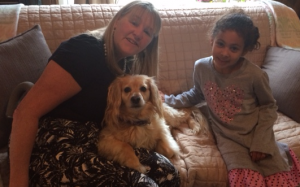
For most of us, spring brings a sense of renewal and new beginnings.  It’s a time to look ahead with optimism and a new sense of possibility.  It’s also a perfect time to tell the story of one of the Nova Scotia SPCA’s adorable alumni named Cherry.
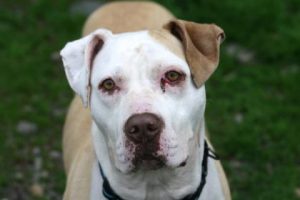
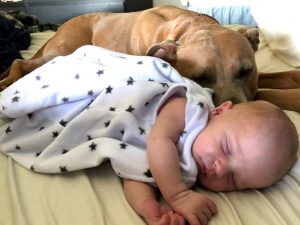
Cherry’s story started May 2019 when she was brought to safety at the SPCA. Her life to this point had definitely been hard. She had been kept tied up on a short chain, was extremely hungry and under-socialized when she arrived at the shelter.

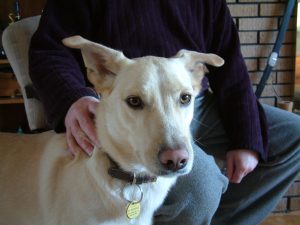
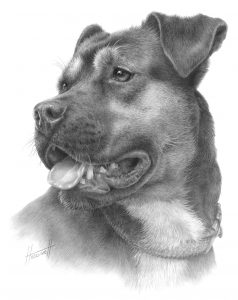
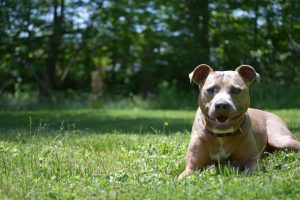
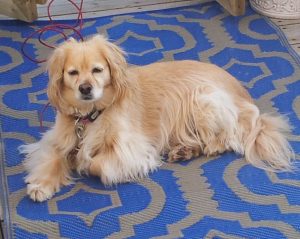
A beautiful blonde Amstaff Terrier, Cherry was approximately five years old. Receiving needed medical care was the first step towards a bright and promising future for Cherry. But she was still very timid and shy and needed some major socialization. Shelter staff and volunteers showered Cherry with love and attention to build her trust and confidence. By the end of June, she was ready to find that special family meant just for her.
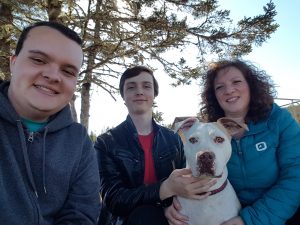
As it turns out, Cherry didn’t have to wait long. On June 29th, Tracey Hilchie’s son Nick was on the SPCA website. Tracey explains “Our beloved Rottweiler Abbey died in December 2018 and we were ready to give a loving home to another deserving dog. Nick had been keeping an eye on the SPCA website for a few weeks when he spotted Cherry. We were drawn to her incredibly cute face. When we did our meet-and-greet, she was very energetic and bouncing around with excitement at the thought of a new home. She kept going to the door and looking outside, as much as to say ‘let’s go!’ We knew then that she was ours.”

Just as actual cherry blossoms need the warmth of the sun to grow and thrive, so Cherry needed the warmth of a loving family for her personality to blossom. Tracey says “Cherry adapted immediately to her new home. She actually slept in bed with Nick on her first night here and she has already called dibs on the cozy spot in front of the woodstove.”
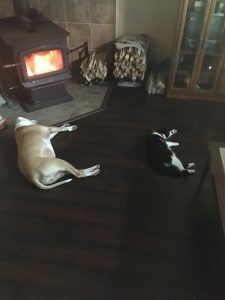
“Cherry loves the attention she gets from our two sons. We adopted our cat Marcy last September and Cherry doesn’t mind her, even though Marcy likes to show her who’s the boss in the house!” chuckles Tracey.

Cherry now has the life she deserves – she realizes that she is home, safe and loved. “She enjoys lying in the sun, going for walks on the beach and exploring every inch of our large rural property,” says Tracey.  “Cherry loves being the centre of attention, and if she feels she hasn’t gotten enough, she lets us know!”

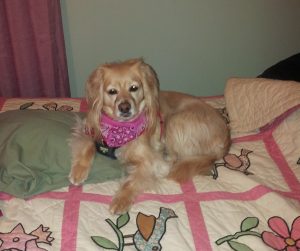
And prepare for cuteness as Tracey relates a couple of Cherry’s eccentricities. “Every night, Cherry fluffs up her bed, makes a pillow for her head and wiggles around on her back in bed until it feels just right.  When she’s ready to come in from outside, Cherry jumps up at the door and sometimes rings the doorbell.   Then, she starts barking because the doorbell rang!”

“This sweet girl has brought companionship and happiness to all our lives,” shares Tracey. “Along with lots of laughter.”  Tracey’s final thoughts?  “The SPCA played a very important role in giving Cherry a second chance at happiness and in finding a family to love her. Her future is bright, promising and filled with love.”


You can give the gift of new beginnings to homeless animals like Cherry.  Please donate today.
 

Judy Layne

Judy is a dedicated volunteer with the Nova Scotia SPCA and proud adoptive fur-mama to Gracie. She is committed to speaking for animals who cannot speak for themselves.

Got Mice? Get Some Barn Buddies!

By Judy Layne

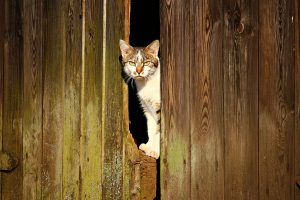
Are you in need of some professional rodent managers?? Would you like to use all-natural pest control?  Here’s the scoop on how you can hire working cats for free!

As part of their ‘No Kill’ mandate, the Nova Scotia SPCA is constantly trying to find opportunities for cats who lack trust with humans and need a special type of placement. The SPCA always strives to find the best outcome for every animal and the Barn Cat Program was created with this goal in mind.

Through TNR (Trap-Neuter-Return), cats are often recovered that are not adapted to living in homes as typical companion pets.  They come from an environment where they have lived outside for most or all of their lives and have either very little or absolutely no direct interactions with people. If placed in a shelter or home environment, they endure immense stress and often act aggressively or are frozen in fear. Although the cat’s preference would be to return to their outdoor home, there are times where they cannot be released back to the property they came from – usually because there is no longer a caretaker.  While these cats don’t want to be house pets, they make wonderful ‘working’ cats and the Barn Cat Program allows them to comfortably live out their lives in a safe environment that is as similar to their ‘home’ as possible.

In these cases, the SPCA tries to find members of the public who are willing to take them in as working cats. The cats come fully vetted – they have been vaccinated, dewormed, flea treated and spayed/neutered.   Plus, there is no adoption fee for cats in this program!

Working Cat Adopters need to commit to:

  • provide a forever home for these cats in a barn or other secure building – for example, a warehouse – where they are safe from wildlife and have a warm dry place to sleep
  • keep them confined for a period of time while they learn about their new home
  • provide ongoing food*, water, shelter and medical care in the future for any illness or injury

*Cats can’t survive on hunting mice alone; they actually catch more mice if they are fed a diet to keep them healthy and strong.

You won’t find these cats on the SPCA website, but you can be put on a waitlist to be contacted when the SPCA has cats in need of a barn placement. The SPCA strives to fit the working home with the temperament of the working cat.

Recently, the SPCA was alerted that a caregiver for a group of cats was in the hospital. These cats, although living outdoors, relied on their caregiver for food. In return, they provided their caregiver companionship in their own way. The caregiver was deeply attached to the cats and loved them very much. Before the caregiver’s death, the caregiver expressed their wish that other opportunities could be found so the cats could live happy lives. The SPCA fulfilled their wish.

The cats trusted their one human caretaker but had never experienced indoor life. Because of this, many of them are happier in similar surroundings. Barn environments are a great way for the cats to decide at their own pace when and how much human interaction they want. As with all animals, working cats should be treated with kindness and caring. But it’s important to understand that they do not want to be treated or handled like indoor pet cats.

To reduce the stress and shock on their lives, the SPCA minimized the amount of time the cats were contained. The cats were medically assessed, spayed/neutered and evaluated for the living situation that would be purr-fect for their unique needs. Of the 51 cats recovered, 27 cats showed their preference for a more independent living situation and were placed in working home environments. The remaining 24 are being adopted or are in foster for further evaluation.

The program is a definite win-win.

  • Working cats benefit their caretakers! They provide all-natural rodent control. There are no poisons for children or pets to get into and no need to set endless traps. They’ll help keep rodents away from grain and food storage areas, and you’ll enjoy watching the cats and having the satisfaction of giving them a much-needed home.
  • For feral and semi-feral cats, this is a dream solution! They are placed in forever homes in barns or other buildings where they are safe, wanted, valued and cared for.

Feedback from folks who have adopted cats through the program has been overwhelmingly paws-itive. I caught up with Valerie who told me that they adopted 2 cats recently. “Our daughter named the cats Riri and Fifi. They’ve only been with us for 3 weeks, but they’ve made a huge impact already. We’re thrilled that all the rodents have moved out of the grain storage shed!” says Valerie. The cats have settled in very well in a short time. “RiRi and Fifi are the best of friends and love snuggling together in the shed window while they soak up the sun. Our whole family enjoys watching them in the window,” she relates. “We decided to get the cats comfortable with one person first, so my husband Neil brings them their meals each day. They really love canned cat food and they don’t run away from him anymore. RiRi and Fifi will eventually be introduced to our family’s other barn cat Luna and our sheepdogs who keep all our animals safe. We’re one big happy family!”

If you have a nice warm barn or building that needs a cat patrol or if you know of an opportunity to place one or more working cats, please contact the SPCA – email:  catcolony@spcans.ca or fill out the adoption application and specify ‘Barn Cat’ in the location.  Together, we can give these special cats a second chance at living a happy and healthy life!


Judy Layne

Judy is a dedicated volunteer with the Nova Scotia SPCA and proud adoptive fur-mama to Gracie. She is committed to speaking for animals who cannot speak for themselves.

Four-legged Superheroes

By Taylor Mundy

Dogs are loving, loyal and supportive. So… what could be better than one dog? Well, how about two dogs?!

Brenda and John were inspired to be a two-dog family. On top of doubling the cuteness, they believed having two dogs provided added benefits for playtime and training.

Timber, their first SPCA alumni, was incredibly smart and intuitive. In fact, he was a self-taught seizure alert dog for John when he was experiencing medically unexplained episodes. Timber’s superpowers helped detect John’s ever-changing brain patterns minutes before John or Brenda were aware. Not only would he tug at John’s sleeve until he followed Timber to a couch or bed, but Timber would also fetch Brenda and watch over John until he recovered.

Naturally, because of this, Brenda and John trusted Timber’s instincts. Timber was officially in charge of choosing his partner.

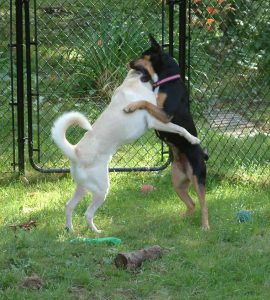
Brenda and John had a number of meet-and-greets at the Dartmouth SPCA to see who the best fit for their family would be. “As female dogs were brought out to meet him, he began bouncing on his two back legs and barking his head off,” recalled Brenda. “Timber was almost renamed Tigger to accurately depict his overly exuberant personality. Each would take one look at his enthusiastic antics and back away.”

Finally, only one female dog, Katie, was left. It was a perfect match! Katie instantly loved Timber and he loved her right back.

But Katie still had a long journey of healing ahead.

Rescued in 2008 with dozens of other pets, Katie was pregnant and rushed in for immediate care. Before coming to the SPCA, Katie was extremely neglected. She was still recovering physically and emotionally when she gave birth to 9 puppies. Katie was a great mama and gave her pups the love and care she never had.

“Katie was ‘trained’ by Timber who absolutely loved teaching her how to be a pet dog,” Brenda remembered. Katie needed one-on-one support to learn how to trust again. Slowly but surely, Timber helped inspire Katie to forgive and she warmed up to humans.

“In time, she began coming to us for love and pats and subsequently became the sweetest dog ever,” Brenda explained. “As Katie emotionally healed, she began loving every human and dog she met. She also became a playful puppy again.”

Katie began to show off her adorable personality and her special superpower… “Unconditional love (especially giving kisses) and forgiveness,” shared Brenda.

Sadly, Timber made his way to Rainbow Bridge. Katie, Brenda and John miss Timber but are thankful to have each other and their health. “She and Timber always slept beside one another on dog beds in our bedroom,” Brenda recalled.

In time, Katie will help choose the next doggo that Brenda and John will welcome into their loving family. Until then, they are cherishing each and every day they have with Katie. Where Katie was rescued, we were unsure of her age. Brenda shared with us the exciting news that Katie’s veterinarian aged her to be around 21 years old. That means Katie would be more than 100 years old in human years! “She is rather slow-moving and cautious these days,” explained Brenda. “However, she can still move very quickly when she sees a squirrel; but has never been fast enough to catch one (thankfully).”

Brenda shared that she hopes learning about Timber and Katie’s superpowers helps to inspire more people to adopt and support the SPCA. “I highly recommend that potential dog owners check out the SPCA,” she said. “Patience is key to finding the perfect dog to adopt. The reward far exceeds the wait time.”

Plus, you never know what doggo superpower you will get! “Katie can raise the roof off the house when she snores,” giggled Brenda. “While not really a superpower, it makes us happy and smile knowing she is still with us!”


Taylor Mundy

Taylor is the Communications & Development Officer with the Nova Scotia SPCA and proud adoptive fur-mama to Bonnie and Clyde. She is passionate about raising awareness and funds for local animals in need.

Lifelong Dream of Changing Lives

By Taylor Mundy

Ever since Ryan Maclean was a young boy, he always loved dogs. He enjoyed learning and teaching tricks and basic obedience. But it wasn’t until Ryan met a special dog named Zeus that he was inspired to begin a dog training business.

In 2014, Ryan and his wife first met Zeus at a shelter in Quebec. “He was born into a shelter and spent his first 8 months of life there,” recalled Ryan. “Although the Nova Scotia SPCA is no-kill, many other shelters place expiry dates on pets due to capacity issues. Quite simply, these dogs all have so much love to give and not much time to give it. Dogs that are not claimed or adopted by the expiry date get euthanized. Zeus came from a shelter like this.”

With zero socialization, Zeus had developed a lot of unwanted behaviors like nipping and jumping up – particularly towards men. “His name at the time was Zoomer,” shared Ryan. “He had a tendency to get the zoomies and just go on uncontrolled sprints for 10 minutes at a time. If you tried to get in his way to stop him… think of it as you are the bowling pin and he’s the ball.” Ryan enrolled Zeus in obedience classes to help work through these concerns.

The trainer, Megan, was extremely helpful and inspired Ryan to learn more. “I was invited back without Zeus just so I could see other behaviours and how to overcome them,” explained Ryan. “That transitioned into tagging along to private lessons that dealt with behaviour modification. Of course, I hit the books and absorbed all of the information that I could surrounding positive reinforcement dog training techniques and behaviour modification.”

Zeus was making positive progress and the family was eager to help another pet in need. In 2015, after the Nova Scotia SPCA seized more than 20 dogs and pups, it seemed like fate. Ryan and his wife were one of the first families to apply and were invited to meet the puppies. “Nova was the only one who immediately came up to us without any apprehension and engaged,” smiled Ryan. “This led us to saying she was the one. But the decision was not just up to my wife and I… it was also up to Zeus.”

We arranged for a meet-and-greet for Zeus and Nova to see how they would interact. After a few sniffs they began playing right away! “Zeus even had a pee right after meeting her and Nova passed underneath him; we call that her christening into the family,” laughed Ryan.

After close to two years of shadowing Megan and studying dog training, Ryan started plans to open his own part-time business. On January 29th, 2017, he proudly opened MAX Potential Dog Training, lovingly inspired and named after his childhood dog.

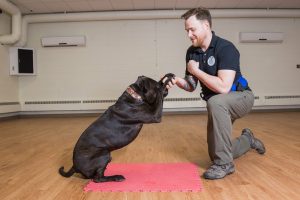
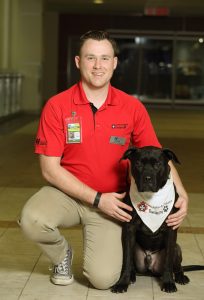
With MAX Potential Dog Training, Ryan began helping other dogs become the best version of themselves. On top of that, he continued to work with his own dogs to become certified Therapy Dogs. The test involves a number of simulations and tools that the dogs would not normally see to gauge their reaction. By establishing solid ‘Focus’ and ‘Heel’ commands, Zeus and Nova passed with flying colours and were both approved to work in long-term care facilities.

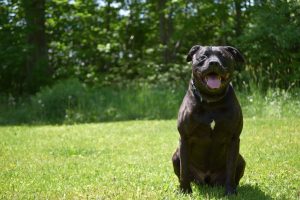
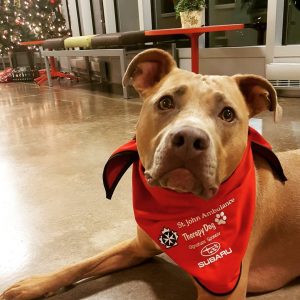
After a year, Ryan took Zeus back to get further certification and he became a special needs therapy dog. The same dog who used to be obsessed with zooming around was now helping seniors and children. “I ultimately worked towards attaining this because it puts a much-needed positive light on the breed,” Ryan shared. Zeus and Nova, both American Staffordshire Terrier mixes, are unfairly stereotyped against. “I believe the discrimination comes from a lack of understanding about these breeds and their history. Ignorance fosters fear and unfortunately many people I have met that dislike these breeds are often those that have either never met one of these dogs or have never had a negative interaction with them at all.”

When 2020 hit, everything changed. Ryan was forced to stop private in-home lessons and the facility he was using blocked all rentals. Determined to help dogs and their families, Ryan created online training videos. “When new dogs owners want training, it’s not like buying a toy or a bed – another box to tick on a list – it’s something that they have an immediate need for,” explained Ryan. “I recorded videos of myself doing the course curriculum. Once per week, we would meet online to cover the behaviours for that particular week. I would use my dogs for demos and of course answer any questions folks had.”

The online class is extremely helpful and gives families an opportunity for a journey with their dog. “Our client receives a weekly email letting them know when a new week is unlocked,” explained Ryan. “There is also a ‘Submit Your Progress’ portal where a person can record themselves working on a behaviour with their dog that comes straight to me to review and provide feedback. This shift to an online model enables pet owners that cannot attend a class to get the same curriculum, guidance and support.”

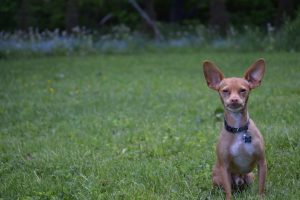
This year has been challenging but there have been some happy moments and silver linings. Ryan and his wife welcomed their new son, Simon, into their pack. Crash, their Rat Terrier mix rescue, fell in love with Simon. “Simon is definitely Crash’s favorite human in the house at this point,” laughed Ryan. “When they first met Crash sniffed him and backed off. Simon then let out a cry and Crash went to check him out again to console him. Their relationship has grown from there.”

Ryan hopes to inspire dog owners to invest in training and to consider adoption first. “Breeders breed dogs based on supply and demand and therefore can slow down if more folks consider adoption first,” he shared. “Shelters have populations of dogs that were bred yesterday but need a home more than ever… today.”


We have exciting news! Ryan and MAX Potential Dog Training are generously offering their online course at a huge discount for SPCA supporters. You can get the course, valued at $120, for 50% off… only $60 taxes in. Use the discount code SPCA50 today!


Taylor Mundy

Taylor is the Communications & Development Officer with the Nova Scotia SPCA and proud adoptive fur-mama to Bonnie and Clyde. She is passionate about raising awareness and funds for local animals in need.

How a Pussycat Became a Princess

By Judy Layne

Inspiration………. it’s what speaks to our hearts………. lets us turn our passion into action……. lets us do more and be more. Here’s the story of how some inspired people helped turn a pussycat into a princess……

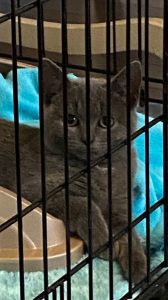
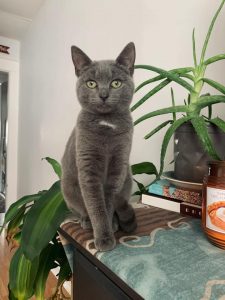
The kitten had no name when she was brought to safety at the Pictou SPCA Shelter. She had been born into a feral cat colony. In mid-October last year she was recovered, along with 3 litters of kittens and 10 adult cats, by our friends at CARMA’s Pictou County Chapter through their TNR (Trap, Neuter, Return) Program.  The shelter named her Little Owl.

CARMA stands for Cat Rescue Maritimes.  The Pictou County Chapter offers a TNR program for community cats in the area.  The organization is comprised of volunteers of all ages and walks of life, and the program they provide is invaluable.  I had a chance to talk to Jane, one of CARMA’s dedicated volunteers, who filled me in on the program.

Jane shares “I’ve been with CARMA for 5 years. The most inspiring thing for me is knowing that CARMA provides a service that no one else does in our county; caring for community cats – cats that for the most part are not socialized and therefore not considered adoptable. I see the difference TNR makes; how it not only saves lives but offers community cats quality of life! We don’t just spay & neuter; we do what needs to be done based on veterinary recommendations.  We respond to sick and injured cats and although difficult, when necessary, we help to end their suffering at the hands of our compassionate vets. We recover kittens and poor, scared, friendly strays, removing them from the harshness of community life. We provide winterized shelters and support with food whenever and how much resources allow.”

Jane continues “In addition to helping the cats, I was unprepared for the impact we are having on caregivers’ lives, often older people on fixed income who feel overwhelmed and would go without to feed the cats.  TNR provides them with a managed healthy colony and they know they can call us for future support.”

“The pawsitive partnership between CARMA and the SPCA’s Pictou Shelter is critical,” explains Jane. “Together, we’ve been able to help so many more cats and kittens then we could have on our own. We provide TNR for community unadoptable cats and the SPCA provides care and services to tame stray cats and kittens – an absolute win/win!”

As it turns out, Jane was there on the day Little Owl was recovered. She relates “The kitten was living with her colony on a small working farm in rural Pictou County. Her colony was very lucky, as their caregivers are kind compassionate people who wanted our TNR services and were happy to have the kittens taken for fostering and ultimately adoption. The adult cats trapped with Little Owl were spayed and neutered, and returned to the colony where they are well cared for.”

Jane was also inspired to become Little Owl’s foster fur-mama, along with a much younger kitten from the same colony!  “It’s hard not to foster when you see their little faces and know with some time and patience, they will be adoptable; it makes all the challenges worth it,” says Jane. “For Little Owl and other timid older kittens like her, it can take a bit more time gaining their trust while offering them a safe space where they become socialized and build their confidence.  It’s a privilege to play a small part in their lives.”

Jane recalls “One of the sweetest things about Little Owl was that she would start purring the minute she saw you or heard your voice even if she wasn’t yet brave enough for a cuddle.  Her sweet gentle nature was clear. I knew she’d make some family very happy.”

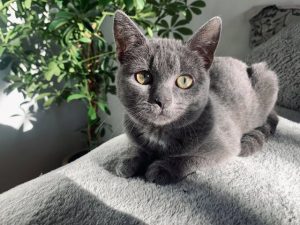
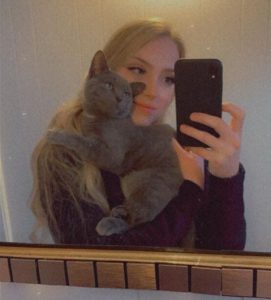
As soon as Little Owl was ready for adoption, it didn’t take long for a family to discover this wonderful girl. On November 27th, Alexus St. Onge spotted her on the SPCA website.  Alexus says “I had been wanting to bring a kitten into our home for a while and once I saw her big ‘owl-like’ eyes, I fell in love instantly.  Her story inspired me even more.”

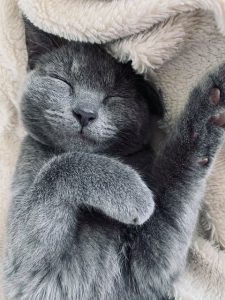
“It took Little Owl a week or two to adjust to her new home,” reports Alexus.  “She hid under the bed and wouldn’t come out until she was ready.  Now, she’s come right out of her shell and runs around day and night!” The family was inspired to re-name their bundle of joy.  “We call her Princess Zelda (Zelda for short) because she truly acts like a princess.  She walks around the house like she owns the place,” laughs Alexus.

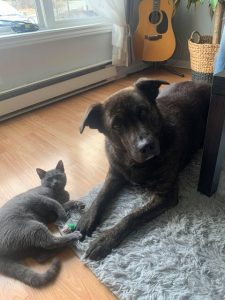
Zelda inherited a canine fur-sibling, a German Shepherd mix named Pepper.  Alexus shares “It took Zelda a while to trust Pepper but now they cuddle and play.” And Zelda’s favorite things?  “She loves playing tag with Pepper, sleeping on Pepper’s back, stealing hair elastics, climbing up to my shoulder where she can hang out like a parrot, and waking me up at 2 or 3am for cuddles!” chuckles Alexus.

“Zelda has definitely brought more joy and excitement into our lives,” states Alexus. “And there’s an unexpected plus. Pepper tended to be lazy and Zelda gets her up and running around the house like a puppy again.  Zelda is Pepper’s new best friend and it’s the best thing I could ask for.”

Alexus’ final thoughts?  “The SPCA plays such an important role in giving animals like our Princess a second chance at happiness.  A kitten who was shy and timid is now an energetic, playful adventurous cat.  We are forever grateful.”

We hope you are inspired by this story.  You can help other homeless animals like Little Owl achieve their fairy-tale ending. Learn more about how to support the SPCA and share your love.


To learn more about TNR, report a cat colony or volunteer your time, click here. If you’re interested in providing food for or managing cat colonies, contact the SPCA and together with local rescue groups, they can provide advice and support. To support TNR activities in 2021, please donate today here.

To learn more about CARMA’s work, the Pictou County Chapter or how you can get involved email PicCo@gmail.com or call 1-782-233-2287.


Judy Layne

Judy is a dedicated volunteer with the Nova Scotia SPCA and proud adoptive fur-mama to Gracie. She is committed to speaking for animals who cannot speak for themselves.

Winnie Inspires a Win-Win

By Judy Layne

It’s said that pets come into our lives to teach us about love. We open our homes and hearts to them and they become cherished members of our families. They show us the wonder that comes from making a loving connection with another living being. For a brief time on this earth, we have a loyal friend who never doubts or judges us….. a caring devoted spirit who delights in pleasing us…… a faithful soul who never wants to leave us.

But leave us they must.  And when they do, it’s devastating.  Even though we know in our minds that their passing is inevitable. And while the daily joy they brought has vanished, the love they gave us never dies; it becomes a part of us forever.  And they continue to inspire us long after they’ve crossed the Rainbow Bridge.  No one knows this better than Heather Compton.  Here’s the inspiring story of her sweet girl Winnie.

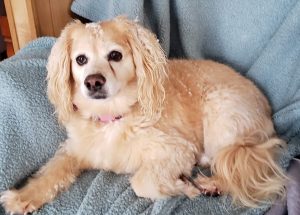
“I heard about Winnie in May 2008 and her sad story moved me,” relates Heather. “Only five months old, Winnie had been mostly kept in the basement of her owners’ home; she didn’t get the love and care that every animal deserves.  She was such a beautiful girl – a cocker spaniel/golden retriever mix.  One look at her loving sad eyes and that was it for me.”

“Winnie came to me at a crucial time in my life,” Heather explains.  “I became a widow shortly after adopting Winnie and because of her, I never felt lonely.  As well, I had just been diagnosed with multiple sclerosis and Winnie was always willing to adapt to whatever I could do each day.  Winnie made an incredible difference in my life. It seemed that we really needed each other and in return, both our lives were made so much richer.”

Heather says “Winnie was my constant sidekick.  Going for car rides definitely topped her list of favorite things, along with getting treats and believe it or not, going to the groomers!  One year, we visited all the Provincial Parks which was incredible.  Winnie was so friendly with people; they were immediately drawn to her.”

Then in May last year, after 12 amazing years together, Winnie passed away.  “One day, I noticed that Winnie was very weak and couldn’t get up.  Within a few minutes, she was gone,” Heather shares. “Winnie was my baby.  I was devastated and depressed from losing her. I miss her every day, but she’ll be in my heart forever and I’ll carry the wonderful memories we made together with me always.”

Heather explains “I wanted to find a way to honour Winnie’s memory and let the gift of her love help other homeless animals. The SPCA’s weekly 50/50 draw was the perfect way for me to do that. I knew that if everybody bought a ticket, it could help greatly and make dreams come true.  And buying online is very easy and safe in this Covid-19 environment.”

Heather never thought that she would win, but she ended up being the lucky winner during week 27 of the draw!  The jackpot that week hit $10,850 so she took home half and the other half went straight to helping homeless pets in need.  “Winnie inspired me to be positive and to show kindness; I feel like her spirit was watching over me,” says Heather.

In this Covid-19 world, many people are struggling.  The SPCA started the 50/50 initiative because they wanted to find a way to help animal lovers AND raise crucial funds for homeless pets – a definite win-win.  You can make a difference from the comfort and safety of your home.  If Winnie’s story has inspired you, please show your support by buying a ticket.  Who knows – you could be one click away from being the next lucky winner! Click here.


Judy Layne

Judy is a dedicated volunteer with the Nova Scotia SPCA and proud adoptive fur-mama to Gracie. She is committed to speaking for animals who cannot speak for themselves.