Spreading Smiles, Nea-Style

By Judy Layne

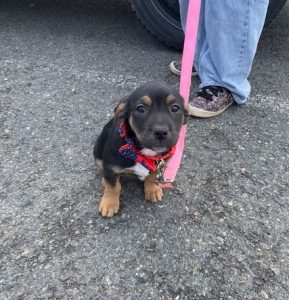
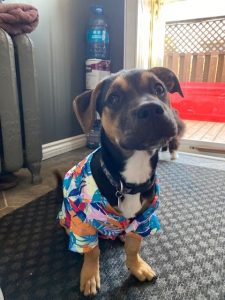
We’ve all heard the phrase ‘working dogs.’ We know there are police dogs, service dogs, and herding dogs to name just a few. But have you ever heard about a canine with a corporate career?? Well, you have now. She’s a proud SPCA alumni and her name is Nea. This is her story.
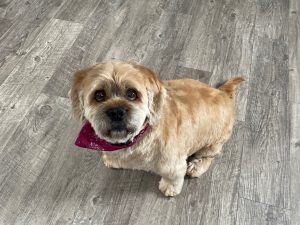
In 2011, Nea was found stray and brought to safety at the SPCA’s Yarmouth Shelter. She was there for some time but due to a lack of space, she was transferred to the Dartmouth Shelter on March 15th.  Five days later, Nea met her perfect match!

Paula Taylor knew she wanted to adopt a deserving dog and had been checking the SPCA website when one day, Nea’s photo popped up. Paula explained “I guess you could say it was love at first sight. I was drawn to her sweet face and she was the perfect size dog for me – too big for a purse but small enough that I could pick her up in my arms! When we met in person, Nea put her head on my knee, looked up with adoring eyes, then sat beside me. I was told that Nea had adopted me!”
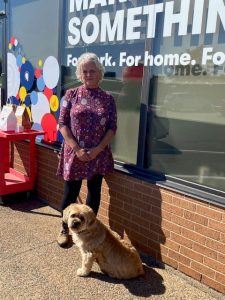
One day, Paula decided to take Nea to work with her at TPH – The Printing House – in Dartmouth. It didn’t take long before Nea won the hearts of employees and clients alike. She was so good at spreading smiles that she became the store’s official Greeter and Client Relations Specialist! “Nea has the perfect personality for the role – she is sweet, kind and well-behaved,” shared Paula.  “Coming into a print shop, especially for the first time, can be intimidating. Nea welcomes our clients and helps them relax and feel comfortable. She will sit beside them and her quiet presence is calming.”
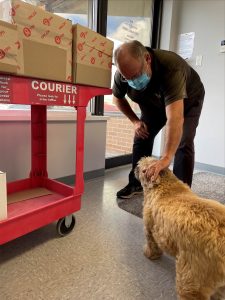
“When it comes to work ethic, Nea is a true professional. She loves coming into work every day to greet our clients,” said Paula. “She’s never missed a day of work and takes her role seriously.” Like every professional, Nea knows it’s important to re-charge your batteries during the workday. “Nea has her own locker with treats in it, so at break time, she makes a beeline for the locker room!” chuckled Paula. “She also takes a well-deserved snooze in her bed. She loves sleeping on her back in the office but will go into ‘Greeter-mode’ whenever a new client enters the store. When the Fed Ex truck arrives, she always wakes up and growls at the truck. She doesn’t like the backing-up noise the truck makes since it wakes her up. It’s the only time she’s ever grouchy at work!”
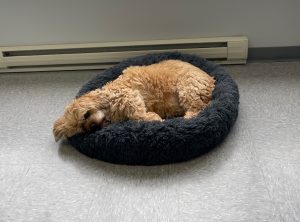
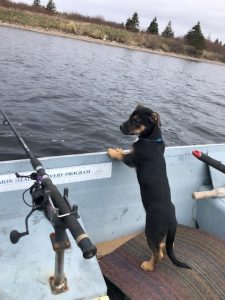
Clients and delivery people often ask for Nea when they arrive. Paula stated “If she isn’t right there, they’ll ask where the ‘boss’ is and magically Nea rounds the corner to see how she can help.” Management spotted Nea’s potential early. And while they offered her a promotion to the Director of ‘Pup-lic’ Relations, Paula reported that “Nea loves ‘working for hugs’ and has no desire to leave her role as official Greeter.” Nea is a firm believer in the ‘work hard, play hard’ philosophy. “She enjoys going to off-leash parks and trails, loves swimming and going for rides in the car.”
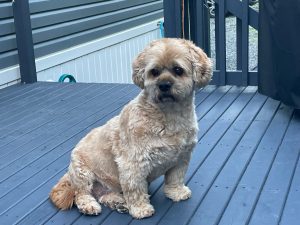
As part of writing this story, I googled the name ‘Nea’ to see if it had a special meaning.  It’s original meaning was ‘lime blossom.’ It’s said that if you name your little girl Nea, she will surely blossom into a woman with a sense of purpose and passion throughout life. What a perfect description of Nea!

Paula shared her closing thoughts. “Nea and I have been together for eleven wonderful years now and she is the best dog a person could ask for. I had been told that rescue dogs are grateful and I didn’t understand this saying until I found Nea. I can see the love in her eyes every day. I believe Nea came into my life to teach me something. She helped me see that the life I was living was not the best situation for me. As a result, I completely changed my life and now we are both much happier and appreciate our new life. Without her, I don’t think I would have been so bold. I’m so grateful to the SPCA for giving Nea a second chance at happiness and allowing me to adopt my best friend.”

 We hope that Nea’s story inspires you to adopt YOUR best friend!  They are waiting for you. Check out the SPCA’s adorable adoptables right here.

Judy Layne

Judy is a dedicated volunteer with the Nova Scotia SPCA. She is committed to speaking for animals who cannot speak for themselves.

It’s Hip to Snip

By Taylor Huestis

Beginning way back in 1979 and continuing for the next three decades, Bob Barker, the beloved past host of the Price is Right, finished each episode with his mantra message: “This is Bob Barber reminding you to help control the pet population – have your pets spayed or neutered.”

Bob’s voice is one among thousands who have helped create a humane movement to reduce the number of homeless animals. Spaying/neutering is one of the most important things you can do for your pet, your family, and your community.

It’s also one of the many services offered to everyone at the SPCA Veterinary Hospital.

“Spaying/neutering your pet is an important part of responsible pet ownership not only to help control the pet population but also to help reduce the risk of certain health conditions in your pet,” Dr. Wuhr, the Director of Veterinary Services at the Nova Scotia SPCA, explained. “Neutering or spaying has a profound effect on reducing and/or eliminating the incidence of diseases that involve the reproductive system.”

“Spaying or neutering does not change their personality, but it can help decrease some undesirable behaviours such as urine marking/spraying in the house, roaming, and lessening hormonal aggression between males,” Dr. Wuhr added.

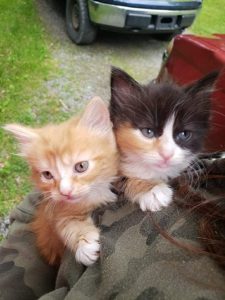
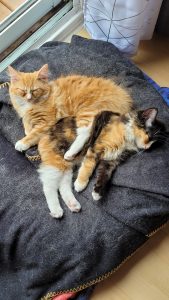
Adam’s family was looking to add another furry friend into the mix. Adam, his wife, and three kids had previously adopted an adorable cat, Pickles, from the SPCA. Pickles needed a buddy. So, when a family friend reached out and said they knew a nice lady needing a home for one kitten, they thought it was fate.

“We immediately said yes and would take her (Dill) home,” Adam recalled. “The next day she had sent us pictures but then we found out Dill’s sister (Randy) didn’t have a home. I went with my heart and said yes right away. Something just told me the two of them are the ones and we can give them a great home and the rest is history.”

Because Adam adopted Pickles from the SPCA, they were somewhat familiar with the SPCA Veterinary Hospital. “But we didn’t realize we had access to it if we needed it,” Adam shared. “When we decided to get Randy and Dill spayed we got in contact and wanted to show support so we decided to take them to the SPCA Veterinary Hospital.”

That’s one of the best parts about the SPCA Veterinary Hospital.

When you book your pet’s vet appointment with the SPCA Veterinary Hospital, you help all pets. Profits from our social enterprise hospital are used to care for pets and families in need. That means more animals will get the medical, surgical, and wellness care they deserve.

Randy and Dill had a wonder-fur experience. They were dropped off in the morning and picked up mid-afternoon. “Recovery was simple but being kittens keeping the cones on after the spay was a challenge,” Adam giggled. “We were able to get it done and both cats recovered within a week or two with no issues.”

Randy and Dill will reap lots of benefits now that they are both spayed. Dr. Wuhr shared:

  • For gals – “Spaying your dog or cat will reduce her risk of developing mammary tumors and eliminate the incidence of diseases that involve the reproductive system.”
  • For the fellas – “Neutering your dog or cat can help reduce their risk of prostate problems and prevent testicular cancer.”

So, when you get your pet fixed your pet will live a longer, healthier, and happier life. You’ll also avoid expensive and serious health problems in the future.

A big thank you to Adam’s family for booking Randy and Dill’s appointments with the SPCA Veterinary Hospital and making the important decision to spay it forward.


Taylor Huestis

Taylor is the Communications & Development Officer with the Nova Scotia SPCA and proud adoptive fur-mama to Bonnie and Boy. She is passionate about raising awareness and funds for local animals in need. Connect with Taylor at thuestis@spcans.ca or 902-222-0378 today.

A Puppy Surprise

By Taylor Huestis

What do you do if you unexpectedly find yourself with lots of tiny new paws? Well, that is exactly what happened to Paige.

Paige had plans to get her beloved dog, Stella, fixed at a veterinary clinic in Sydney. Stella, on the other paw, had other plans.

“She went into heat and the next thing I knew… there were pups on the way!” Paige recalled.

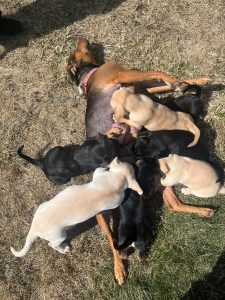
In fact, there were seven itty-bitty pups.

Unsure of what to do, Paige reached out to her vet who encouraged her to get in touch with the Nova Scotia SPCA and ask about the P.U.P Program, which stands for Prevent Unwanted Pregnancies.

With the P.U.P Program, not only will we fix your female dog or cat for free, but we’ll also find loving families for the puppies or kittens.

“I had contacted the SPCA to get more information about this program,” remembered Paige. “Ever since the very first phone call, the staff went above and beyond anything I expected to help me. They let you know what is going to happen through every single step. Over the next eight weeks, the pups were vaccinated, spayed and neutered before going into their fur-ever homes. Then once they are placed in their new homes it’s time for mama to get fixed… for FREE!!”

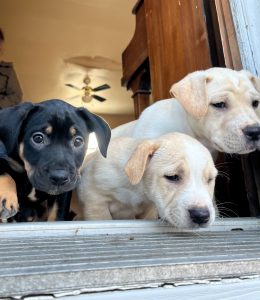
Stella’s seven pups became known as the M litter at the Cape Breton SPCA – Michelle, Marshall, Maize, Marcus, Maxxie, Mathew, and Maya.

“The SPCA will also help supply food for the pups when they are able to eat kibble,” Paige grinned. “That was super helpful as keeping up with puppies can be a challenge. I think this is a super important program for all pet owners because it will help keep your animals happy and healthy while also stopping repetitive letters.”

“With the cost of living nowadays the program and their services could be a huge help to a lot of people,” Paige continued. “This program is 100% something I’d recommend looking into. It can save a life and make families happy all at the same time.”

While Stella recovered at home with Paige, all the puppies were adopted into amazing families. One of the pups, Michelle, got a brand new name and a new life. Her fur-mama, Laurie, thought the name Ivy seemed to fit her cute and quirky personality best.

“I saw her picture and she was adorable,” Laurie shared. “I put my application in and was immediately very excited on the prospect of a new addition to the family. We were unable to see her in person as she did not have all her vaccines and couldn’t put her at risk, so her picture was posted on the fridge until we received the call.”

On Easter morning, Laurie and her family dropped into the shelter to pick Ivy up.

“We were so excited,” Laurie smiled. “We bought the leash, the kennel, the bed, the toys – we were ready. We decided to go to a training class as we did not want to put ourselves in a position of having a naughty pup that was of our own doing. It helped. We were reminded we could love our pup and instill good habits. Pups are work; however, it is very rewarding.”

“Ivy has been great for our family,” gushed Laurie. “We are more active as we ensure she has her exercise. We have something we can share; we discuss her accomplishments; we all go on more outings like to the beach to see how Ivy likes new experiences. Both our mothers are involved in her care and will watch Ivy if we need them.”

Amusingly, Ivy is the exact opposite of what Laurie thought would be a good match for their family. They originally were set on a medium-sized dog who loved to swim and go on walks.

“She is small, she doesn’t like the water, and she isn’t the greatest for going on walks.” Laurie giggled. “But she is cute, she loves to play, and she is so excited to see us whenever we walk through the door. We all absolutely adore her. You may not get what you think you want but you get what you need. We wouldn’t trade Ivy for any other pup.”

Thanks to the P.U.P Program, Stella and Paige are cozied up at home together not worrying about another accidental litter of pups, and Laurie’s family got the surprise they never knew they needed. But most of all… Now, there are eight happy families.


Accidents happen. You’re not alone. We’re here to help. Click here to learn more about the P.U.P Program today.


Taylor Huestis

Taylor is the Communications & Development Officer with the Nova Scotia SPCA and proud adoptive fur-mama to Bonnie and Boy. She is passionate about raising awareness and funds for local animals in need. Connect with Taylor at thuestis@spcans.ca or 902-222-0378 today.

SPCA Enforcement Responds to 31 Recent Calls of Dogs in Distress in Hot Back Yards

By Judy Layne

By now, everyone should know the dangers of leaving their dog in a hot car.  But there are other dangers posed by summer heat, right in our own back yards. In June alone, SPCA Enforcement Officers responded to 31 calls about dogs in distress in people’s back yards!

Jo-Anne Landsburg, the Nova Scotia SPCA’s Chief Provincial Inspector, shared an overview of the 31 calls received from concerned citizens. All are alarming; one case broke my heart.

  • Dogs are often left on decks without any access to shade. Decks can become extremely hot and are often isolated from any breeze. Hot deck surfaces can burn paws.
  • Dogs are left tied to a tree or other structure in the yard and are not provided with any shade.
  • Dogs often have no water. People sometimes leave a bowl of water, but the tether knocks the bowl over leaving the dog without any water for much of the day.
  • Dogs are left in backyard kennels with a small doghouse for shelter from sun. Many dog houses are not constructed with enough insulation to keep out heat, so the doghouse becomes a hothouse with no other source of shade.
  • People exercise their dogs when it’s very hot outside. Exercising in the heat can quickly lead to heatstroke. Hot pavement can burn paws.

Jo-Anne’s depth of devotion to protecting animals was evident when she told me about one of the troubling hot-weather cases she and her staff of Enforcement Officers investigated. The case broke my heart; I’m sure it will break yours too.

Jo-Anne related “We were called about a dog that was left on a backyard deck in hot weather.

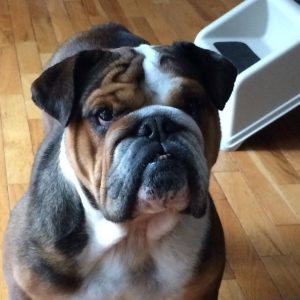
When we showed up, there was an English bulldog on the deck in full sun with no shade and no water. The owner was not home, nor could we locate them. The temperature outside was a hot 28 degrees. Penelope (as she was later named) was panting heavily and was lethargic.

Because we could not locate the owner and could not leave Penelope there in distress, she was seized and taken to the Dartmouth Shelter for medical treatment. During the trip, we turned on the air conditioning and gave her a cool drink. We were very careful not to cool her down too quickly. Penelope was then later diagnosed with Entropion in both her eyes – a condition in which the eyelid rolls inward, causing eyelashes and surrounding hair to rub against a dog’s sensitive cornea. Entropion results in eye irritation and pain, and if not remedied quickly, can lead to corneal ulceration.

We waited for the owner to contact us, but they never did. Sadly, no one came for Penelope or even cared to see how she was. After the appeal period had lapsed, Penelope became property of the SPCA. This meant that we could now get her the surgery on her eyes that she desperately needed.

We returned several times and left several notes on the door. It was later discovered that whoever lived there moved away not long after and we were never able to trace the owner. Thankfully, due to a concerned citizen’s call to the SPCA, Penelope was now in good hands. She was sent to the Veterinary College in PEI to have surgery on her eyes. Everything went well and she was later adopted by a loving family.”

There were so many better alternatives for Penelope’s family; she suffered needlessly. If a concerned citizen had not contacted the SPCA about Penelope, she likely would have perished. Fortunately, her story had a happy ending, but not all dogs are so lucky.

Heatstroke can cause brain damage, organ failure and death. Elderly, very young and overweight dogs, and those with health concerns including heart or respiratory disease are particularly at risk. Some breeds of dogs – bulldogs like Penelope, pugs, shih tzus and dogs with short muzzles may also quickly succumb to heatstroke. These dogs should not be left outside in hot weather under ANY circumstances.

Jo-Anne said there are simple solutions to preventing heatstroke. “We recommend that:

  • Tarps or other materials (ex. landscape fabric) be used as a canopy to offer dogs shade during the summer heat
  • Spill-proof water containers be used to prevent spillage
  • On extremely hot days, pets should have supervised time outside so they can be monitored
  • Exercise your dog in the early morning or evening
  • If you must leave your dog for several hours, it’s often best to keep them indoors where it is cooler.”

Please don’t let this happen to your dog. Learn more about heatstroke below. And if you see a dog in distress, call the Nova Scotia SPCA immediately toll-free at 1-888-703-7722.

Please join with me in thanking Jo-Anne and her team of dedicated investigators for their outstanding lifesaving and advocacy work. These extraordinary champions truly play a critical role in animal welfare in our province.


HEATSTROKE – Know the Signs of Heat Stroke

  • Excessive panting or trouble breathing
  • Heavy drooling
  • Restlessness, discomfort
  • Bright red gums/tongue
  • Lack of coordination
  • Confusion or disorientation
  • Vomiting or diarrhea
  • Lethargy or unconsciousness

If you see any of these signs, move the dog to a cool place, let them drink cool (NOT cold) water and call a vet immediately.


Judy Layne

Judy is a dedicated volunteer with the Nova Scotia SPCA. She is committed to speaking for animals who cannot speak for themselves.

How Helping One Kitten Saved So Many Others: Missy’s Story

By Judy Layne

Did you know that spaying/neutering just one feral cat can prevent anywhere from 100 – 5,000 kittens from being born into harsh conditions where they are at risk of food scarcity, disease and predators?! Here’s how. Cats can begin to breed at just six months old. On average, female cats can produce 1.5 litters per year, with an average litter size of 4 kittens. For feral cats, even though many kittens may not survive to reproduce, research shows that without human intervention, 2 unsterilized cats and their offspring can produce anywhere from 100–5,000 kittens in seven years.

The SPCA’s TNR (Trap, Neuter, Return) Program has been working to improve the lives of feral cats and stop unwanted litters. Since its inception in 2016, the Nova Scotia SPCA has been pleased to support TNR, helping an average of over 1,500 cats a year. This achievement is only possible with the dedication of staff, volunteers, and local rescue groups who work tirelessly to trap, transport, and care for feral cats pre-and post-surgery, and to foster and socialize kittens and friendly cats that are rescued.

Here’s the story of one TNR kitten’s journey………On November 5, 2018, a TNR team brought a group of feral cats and kittens to the Dartmouth Shelter. The kitten was approximately 3 months old and generally healthy when she arrived at the shelter. Shelter staff named her Taffy. After being spayed, Taffy was taken to the TNR Recovery Centre. Because she was still young and showed adoption potential, Taffy was placed into a foster home for a month where she was loved, cared for, and socialized before she was ready to find her forever home.

Taffy became available for adoption on December 8, and it didn’t take long before this special girl was scooped up! Her fur-mom Tami Meredith filled me in. “I had just returned to Halifax after being in B.C. for a year and wanted to find a furry roommate. I’d had cats all my life and know the joy they bring to your home. So, I paid a visit to the Dartmouth shelter in search of the purr-fect feline companion.”

Tami related “I took my close friend and her son, age 3, with me. It was interesting to see how the cats reacted to a sweet innocent child. Taffy instantly decided he was trustworthy. Watching the two of them interact told me all I needed to know – she was good-tempered, curious, playful and a little purr machine.  I was smitten!”

Tami knew that patience was key to helping Taffy adjust to her new home. She explained “Making Taffy feel safe was easy – I gave her all the space and freedom she needed. I let her make all the decisions and she told me when she felt safe. I always let her come to me and didn’t disturb her as she explored and became comfortable in her new environment. I tried different feeding times and different litter box locations, until her behaviours told me what she preferred. One evening, about 2 months after I adopted her, I was lying on the couch reading and she jumped up onto me, curled up and started purring, letting me know she trusted me.”

Tami wanted to give Taffy got a new name for her new start in life. “It took me a while to pick the purr-fect name for my girl,” shared Tami. “As part of the TNR program, her left ear was slightly clipped to provide a visual signal that she had been spayed. It gives her a slightly quirky, adorable ‘misfit’ appearance. She’s very playful and loves to be a bit mischievous. The day I heard a crash, went into the living room and saw her looking up at me, one ear shorter than the other and a shattered plant pot by her paws, my ‘mischievous misfit’ had let me know exactly what she should be called – Missy.”

Missy is definitely living her best life. “Watching the birds outside from her cat tree and just observing the world is perhaps her favorite thing (well, other than mealtime!),” chuckled Tami. “The house is full of her toys and her scratching post is replaced annually due to her enjoyment of it! Every morning, I wake up with her beside me in bed. If I’m sick, she’s always there for me.”

Vestiges of Missy’s life as a semi-feral kitten remain. Tami related that “She is afraid of strangers and tends to ‘disappear’ when guests come over, checking them out from a distance and taking the time to determine if they are ‘good people.’ She took her time deciding if I was her human, but once she did, she became an affectionate, loving, and loyal companion. Oh, the other sign that I’m officially her human is that she never really learned to be careful with her claws and I’m always sporting evidence of this fact!”

“My happy moments with Missy are frequent and daily,” shared Tami. “Her antics always bring smiles and laughter. The SPCA’s TNR Program saved her life. She was young, healthy, and smart enough to survive for some time, but the hardships would eventually have killed her. Today she is a playful, cuddly and sweet four-year old who is totally happy in her forever home. I can open the door and all she does is peek out, likely because she prefers the warmth and safety of a loving home to the challenges of surviving in the wild. I know Missy will be at my side for the rest of her life.”

Prepare for cuteness.  Here are more sweet anecdotes that Tami shared about Missy. 

The Social Media Darling

When Covid struck, I began to work from home and teach my classes online. All my students knew I had a cat because Missy would be on my desk during lectures, sleeping on my keyboard, batting at my hands as I tried to type, and generally being her usual playful self. During one class, she walked across the keyboard, hitting some random combination of keys that muted my microphone. It wasn’t until one of the students sent me a text message a few minutes later that I realized they hadn’t heard a word I’d said for several minutes!

The Cat(nip) Burglar

I was at the Annapolis farmer’s market one Saturday where I purchased an envelope of organic catnip and brought it home for her. It had been a long day and I was tired, so I didn’t think and left it on the kitchen table. The next morning, when I woke up, there was a torn envelope on the floor and the catnip was everywhere, with Missy sleeping contently in the middle of the mess.

The Purr-fect Hostess

I’ve recently taken in a friend’s cat who was being scared by another cat in their household. Missy has been the perfect hostess, letting our guest visit the food bowl first when I put it out each morning. She has never reacted aggressively, always walking off when our guest feels threatened, keeping the peace and being a good friend. I knew the morning I woke up and found one cat on each side of my pillow that my Missy had helped our little fraidy-cat guest feel safe!

Want to be part of the TNR Program? Click here to volunteer to assist with trapping, transporting and caring for feral cats. To report feral cats needing assistance, contact the SPCA: catcoloy@spcans.ca or 1-844-835-4798. If you’re interested in providing food for or managing cat colonies, contact the SPCA and together with local rescue groups, they can provide advice and support. To support TNR activities, please donate today.

Judy Layne

Judy is a dedicated volunteer with the Nova Scotia SPCA. She is committed to speaking for animals who cannot speak for themselves.

MacKays Help Build Home for New Shelter

By Sarah Lyon

They had only gone to look at a truck. Instead of talking about spark plugs, the conversation lit a spark: how can North Nova get a new SPCA?

After a truck caught their eye, Sharon and Elmer MacKay met Vince Angst in his car dealership on Main Street in Stellarton. During their conversation, they learned that Vince was an animal lover like them. For years Vince organized the Kathy Skoke-Fortin Memorial Golf Tournament in support of the Pictou County SPCA but unfortunately due to COVID, that year he could not. He told the MacKays this and the conversation quickly turned from trucks to the shelter in Granton.

At over 43 years old, the Pictou shelter has helped save animals and create families for decades. Currently, it does not reflect the quality of care the animals receive or have the capacity to offer all the Nova Scotia SPCA programs. Since it was originally built, there have been advances in animal welfare, as well as demand for services. This had been evident to Vince, Sharon, and Elmer who had all dropped in on the location over the years. So, why couldn’t a new SPCA be built?

“That’s when we knew the stars had aligned because Vince had on him a business card for Christa Jensen, the Nova Scotia SPCA Director of Development,” says Sharon MacKay. “I took it and I called her and said the area was in desperate need of a new SPCA. And there was silence on the other end of the line.”

The silence was Christa pausing because the SPCA had only just decided to start a capital campaign to build and fix aging shelters across Nova Scotia, and before any work could get started, Sharon was on the phone. “I remember Christa responded with one word: ‘amazing.’”

Sitting in their home a few yards from the original MacKay homestead, Elmer says that “Sharon is one of the kindest people I’ve ever met.” The house, while filled with notable pictures of dignitaries and recognition from Elmer’s political life, is also filled with the soft purrs from three cats that Sharon has rescued. One came right to the front door, while another was first seen in the woods, and needed some time. “She built it a house out back and eventually the cat learned to trust Sharon and came into the house.”
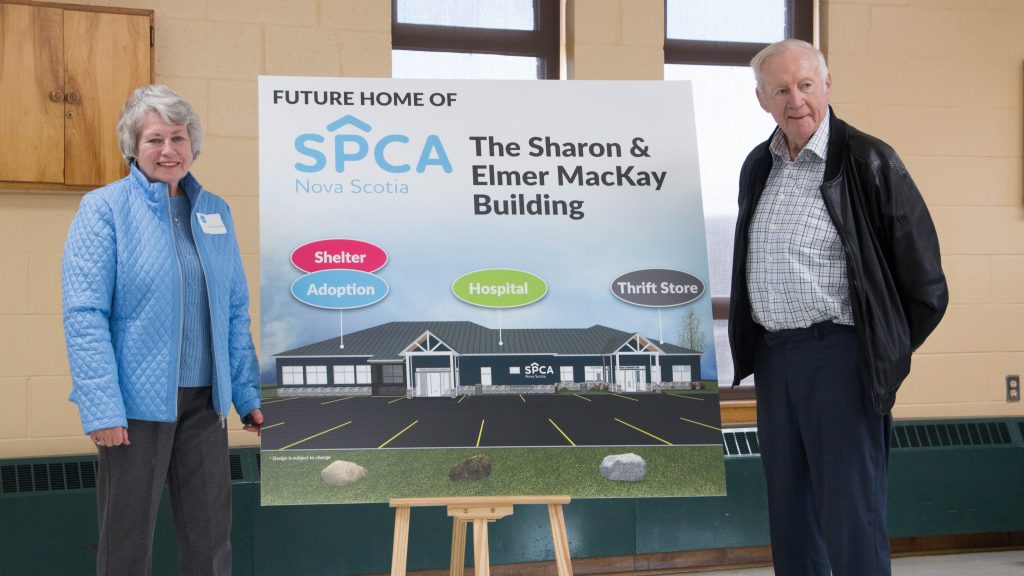
Sharon acknowledges that while she likes dogs, she has a special place in her heart for cats. “I have been taking in strays since I was seven years old. If the neighbours’ cat had kittens, I took them in!” Elmer on the other hand grew up on a farm milking cows and taking care of all the animals, occasionally even helping the raccoons and foxes, and even a groundhog. And while he loves animals, he fondly remembers his first dog a pit bull named Rex.

“Dogs are special,” says Elmer. “They care for their owner. But all animals are unselfish; they don’t make demands, they show unconditional affection. We could learn a lot from them.”

Making sure that animals in Pictou County are taken care of is one of the drivers behind the MacKays giving their support to the new build. “The SPCA is multi-purpose, multi-faceted, and multi-dimensional,” says Elmer. Sharon agrees and notes how important it is that the new location will allow for the expansion of SPCA programs like Paws and Support. “It is exceptional that the SPCA has a program to help with the pets of those fleeing domestic violence or someone who is sick and has no one to look after their animal during a hospital stay.”

The MacKays aren’t shy about their support for the new build, with Sharon admitting that she talks about it to everyone and anyone in Pictou Country. “I saw a woman passing the house walking her dog and said, ‘do you know we are getting a new SPCA?’ everyone is so excited when they hear about it.” The MacKays’ basement has started to fill up with collected items to give to the SPCA Thrift Store when it opens and have been asking friends for their support.

Beyond spreading the word and making sure the shelves in the store will be stocked, the MacKays have made a financial contribution to ensure the legacy of the building. In recognition of their commitment, the Nova Scotia SPCA will be naming the new North Nova facility the Sharon & Elmer MacKay Building. It is an honour that the MacKays humbly accept.

“It is nice, lovely,” says Sharon. “But we would be just as excited about this project and would pass by the building proud of the work we did to make it happen, even if our name wasn’t on it.” Elmer looks at it with pride and humour. “I am very proud of the work that generations of the MacKay family have done in Pictou County. I just hope the name doesn’t detract people!”

After almost 30 years of marriage, countless pets, and watching five championship wins by their beloved Yankees, working together to build a new North Nova SPCA is the first time the MacKays have teamed up for a capital campaign. Inspired by both the volunteerism of locals like Vince Angst, Steve Smith, campaign chair Marsha Sobey, and the incredible land donation from the Town of Stellarton, both Sharon and Elmer have high hopes that this SPCA will be around for 50 plus years itself.

“This will be good for the region,” says Elmer. “Not only for animals, but for families, for the economy bringing jobs. Pictou Country, I believe, is the centre of the universe, and it’s because of the people who I know will be hands-on.” Sharon adds her hope that enthusiasm doesn’t wane once the building is complete. “We’ve got a hospital to build, we have a thrift store to fill, we need to continue as a community, to work together to make it sustainable.”

The MacKays can already see the day the SPCA is open in Stellarton and plan to be there helping out.

Luckily, they bought a truck to drive them there.

Sarah Lyon

Sarah is the Director of Marketing and Communications with the Nova Scotia SPCA. At home, she parents rescue dog Mz. Roxy Roller and son Lochlan. Telling the stories of adopters, donors, and volunteers is what makes her tail wag. Connect with Sarah at slyon@spcans.ca or 902-229-8620 today.