
Sophie Amaral, 18, can’t remember when she started doing art, because it’s just always been part of her life. Her mom, Lesley, remembers the first time she and her husband realized that Sophie was born with artistic talent. “We took her to see a school play, and she was in grade one, maybe two, early elementary school,” says Lesley. “It was the Wizard of Oz, and she came home and drew a scene, and you could tell it was exactly from the play. You could see the characters that this child has drawn, that I as an adult couldn’t!”
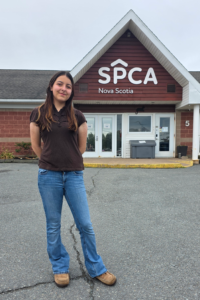 As she grew up, no surface was safe from her drawings. Scrap paper, notebooks, and, if her parents had mistakenly left any important documents lying around, on those, too.
It wasn’t too long before she started asking her parents, “Can you go to school for art?” And as mom Lesley says, “she has been on the path of being an artist ever since.” When Sophie entered high school, she had the opportunity to take an advanced art course. It was more than learning about art; it was about making art. After years of doodling and drawing cartoons, she tried new mediums like charcoal portraits and oil-painted fruit in this course.
In grade 10, through a youth program at the Mi’kmaw Native Friendship Centre, Sophie responded to a call for artists for a new art installation at Halifax’s Scotia Square Mall. This was her first attempt at Indigenous Art – and it was chosen to be on the building. 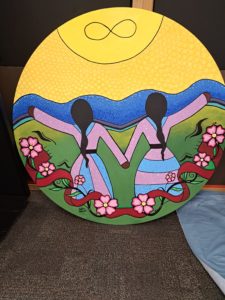
“I started to think about college,” says Sophie. “I wanted to continue my dream of a career as an artist.” At the same time, Sophie was becoming increasingly interested in how her love of art and her identity as a Mi’kmaw woman intersected.
Sophie lives in Nova Scotia and is from the Miawpukek First Nation, located at the mouth of the Conne River on the south coast of Newfoundland. This year, she learned a new form of art by designing dance regalia and proudly wearing that design when she danced in her very first Powwow in her community. “I used my favourite colour, pink,” says Sophie. “I added Mi’kmaq elements such as the double curve motifs, eight point star, L’nuk symbol, and a hieroglyph meaning create.”
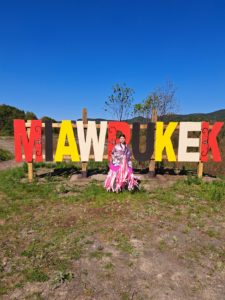 The Miawpukek Band Council sees Sophie’s talent and is financially supporting her educational journey. “Indigenous art is a form of storytelling, and I really wanted to explore that as part of Indigenous culture,” says Sophie. Exploring that has taken her from the East Coast to Toronto, where this month, she started her second year at OCAD University in the four-year Indigenous Visual Culture program.
“School has really helped me to connect with my culture,” says Sophie. “There is a great community of Indigenous students here, and we are learning our history through art.”
Back home in Nova Scotia this summer to spend time with her parents, three cats, and her dog, she was approached for her first-ever commissioned piece of art. The Nova Scotia SPCA was seeking an image to symbolize the organization’s commitment to truth and reconciliation that could be displayed on staff orange shirts or online. 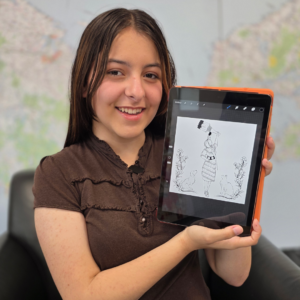
“I was so excited to be asked,” smiles Sophie. “I visited the Dartmouth site and had a tour of not just the shelter, but also Tartan Tails Veterinary Hospital and the Nova Scotia College of Animal Welfare. I learned more about how the SPCA is helping animals in many ways.”
Sophie took to her tablet to start creating an image – and ended up drawing three. The night before she was to present her designs, as she was reviewing them, she thought about all that she had learned on the tour, and a fourth drawing came to mind. It was that drawing that brought staff at the SPCA to tears, and ultimately, it is the one that you will see in shelters, hospitals, and thrift stores.
From Sophie, on her design:
“We start with the main focus, which is the dancer in the middle. She is wearing a jingle dress and doing a healing dance. I chose this because of the work the SPCA does across the organization.
The jingle dress symbolizes the spirit of healing. It came in a dream to a grandfather who was worried because his granddaughter was sick. He woke up and made the dress. His granddaughter put it on and got better.
The dancer is holding a fan, sending prayers for those who are sick, to the creator.
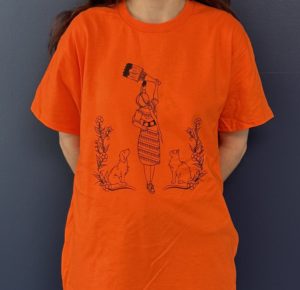 Looking up at her dancing, there is a dog and a cat. Animals have their own ceremonies, so they are not dancing in the art, but animals are important in Indigenous art, and the SPCA helps heal a lot of cats and dogs, so it was important to include them.
Wrapping around the image is a floral border that shows our connectedness to nature. In the florals, you will see the double curve motif, which is used in a lot of Mi’kmaq designs, and which looks like tulips to me.”
The almost 200 staff members at the Nova Scotia SPCA will be wearing orange shirts for National Truth and Reconciliation Day with Sophie’s design on them. Something that the young artist still can’t believe. “I am so excited to see people wearing my art, and I am so glad I got to do this with the SPCA.”
The Nova Scotia SPCA is located in Mi’kma’ki, the ancestral and unceded territory of the Mi’kmaq people. We recognize that our commitment to Truth and Reconciliation goes beyond wearing an orange t-shirt; reconciliation is ongoing and needs to be incorporated into every day of the year.
Learn more about the Truth and Reconciliation report Reports – NCTR.